
How to fix your lower back pain without quitting your desk job
Your Desk Job Is Hurting Your Back — Here’s What to Do About It
Lower back stretches at work are one of the fastest, easiest ways to fight the pain and stiffness that build up from sitting at a desk all day.
Here are the most effective ones you can do right now, without leaving your chair:
- Seated Knee-to-Chest — Pull one knee toward your chest, hold 30 seconds, switch sides
- Seated Spinal Twist — Sit tall, rotate your upper body to one side, hold 15 seconds, switch sides
- Seated Cat-Cow — Arch and round your back slowly, repeat 10-15 times
- Seated Figure-Four — Cross one ankle over the opposite knee, lean forward gently, hold 30 seconds
- Seated Hamstring Stretch — Extend one leg straight from the chair edge, hinge forward at the hip, hold 30 seconds
Quick tip: Aim for just 5-10 minutes of stretching daily. That small habit can make a real difference.
Now, here’s why this matters.
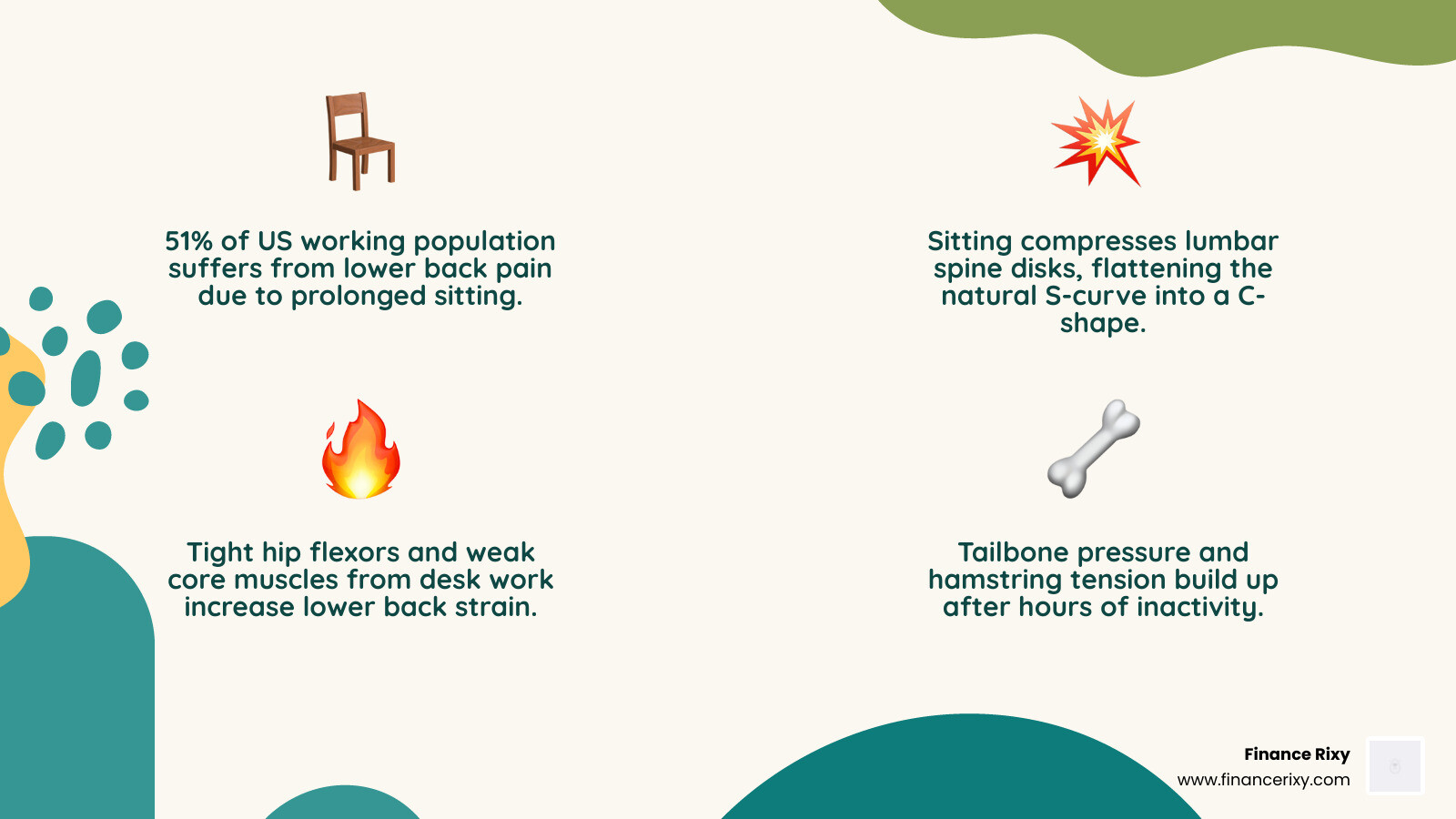
Nearly 51% of the US working population suffers from lower back pain. And back pain is the second most common reason people visit the doctor — right behind upper respiratory infections.
The cruel irony? For most desk workers, the very act of doing their job is what causes the pain. Sitting for hours compresses your lumbar spine, tightens your hip flexors, and weakens your core. Over time, your lower back pays the price.
The good news: you don’t need to quit your job or hit the gym. A few targeted stretches, done right at your desk, can genuinely help.
Why Sitting All Day Triggers Lower Back Pain
To understand how to fix the pain, we first have to look at what’s happening under the hood. Our bodies weren’t exactly designed for the “8-hour sit.” Experts often refer to the health risks of prolonged inactivity as “Sitting Disease,” and the primary victim is your musculoskeletal system—specifically the lumbar spine.
The lumbar spine consists of five sturdy vertebrae at the base of your back, supported by a complex web of muscles, tendons, and ligaments. When we sit, we often lose the natural curve of this area. Instead of a healthy “S” shape, our spine slumps into a “C” shape. This posture puts immense pressure on the intervertebral disks and the tailbone.
But the back isn’t acting alone. Lower back pain is often a “group project” involving several muscle groups:
- Hip Flexor Tightness: When you sit, your hips are in a constant state of flexion. Over time, these muscles shorten and tighten, pulling on your pelvis and arching your lower back painfully when you finally stand up.
- Hamstring Tension: Believe it or not, the back of your thighs can be the culprit. Tight hamstrings pull on the sit bones, which tilts the pelvis and creates a domino effect of tension that ends right in your lower back.
- Core Muscle Weakness: Your core is like a natural corset that stabilizes your spine. When we sit, we tend to “switch off” our abdominal muscles. Without that internal support, the lower back muscles have to work overtime to keep us upright, leading to fatigue and strain.
According to the Mayo Clinic, incorporating just 15 minutes of back exercises into your day can significantly ease this discomfort and prevent further injury.
Essential Lower Back Stretches at Work You Can Do in Your Chair
You don’t need a yoga mat or a gym membership to find relief. Most of the tension caused by office work can be addressed through lower back stretches at work performed directly in your desk chair.
If you’re feeling that familiar ache, try these seated movements:
- Seated Cat-Cow: This yoga classic is easily adapted for the office. Place your hands on your knees. As you inhale, arch your back and look toward the ceiling (Cow). As you exhale, round your spine and tuck your chin to your chest (Cat). This lubricates the spinal disks and relieves stiffness.
- Trunk Rotation: This is a fan favorite for immediate relief. Sit tall with your feet flat. Reach across your body to grab the armrest or the back of your chair and gently twist your torso. This helps maintain the rotation mobility of your lumbar spine.
- Chest Opener: We often hunch forward while typing, which rounds the shoulders and strains the back. Sit at the edge of your chair, reach behind you to grab the back of the seat, and pull your chest forward. This evens out the muscles in your hips and spine.
- Pelvic Tilts: These are subtle enough that your coworkers won’t even notice. While seated, slowly tilt your pelvis forward (arching the small of your back) and then backward (flattening it against the chair).
For a comprehensive routine, you can explore more desk chair stretches that target these specific pressure points.
Step-by-Step Guide to Seated Lower Back Stretches at Work
To get the most out of your lower back stretches at work, form is everything. Here is how to perform the most effective moves safely:
1. Seated Knee-to-Chest
- Sit toward the front of your chair with a straight back.
- Grasp the back of one thigh and gently pull your knee toward your chest.
- Keep your spine tall; don’t lean back to meet the knee.
- Hold: 30 seconds per side.
2. Seated Hamstring Stretch
- Sit on the very edge of your chair.
- Extend one leg straight out with your heel on the floor and toes pointing up.
- Keep your back perfectly straight and hinge forward at the hips. You should feel a stretch down the back of your thigh.
- Hold: 30 seconds per side.
3. Abdominal Bracing Technique
- This isn’t a stretch, but a foundational strength move. Imagine someone is about to poke you in the stomach.
- Tighten your abdominal muscles by drawing your navel toward your spine.
- Keep breathing normally!
- Hold: 10 seconds, repeat 10 times. This builds the internal support your spine needs.
4. Spinal Twist Mechanics
- Sit upright with feet planted firmly on the ground.
- Place your left hand on your right knee and your right hand on the chair’s back.
- Slowly twist to the right, looking over your shoulder.
- Hold: 15-20 seconds per side.
The 30-Second Rule: For most static stretches, 30 seconds is the “sweet spot.” It gives the muscle fibers enough time to actually relax and lengthen.
Standing Lower Back Stretches at Work for Quick Relief
Sometimes, the best thing you can do for your back is to simply stand up. If you have a moment between meetings, try these standing variations:
- Standing Lumbar Extension: Stand with your feet shoulder-width apart. Place your hands on your lower back (on your “back pockets”) and gently lean backward. This “undoes” the forward slouching we do all day.
- Forward Fold: Stand and slowly roll your spine down toward the floor, letting your arms hang heavy. This uses gravity to decompress the vertebrae.
- Standing Neural Glide: This is excellent for those who feel “tightness” that feels almost like a nerve pull. Place one heel on a low stool or the base of your chair. Flex your foot toward you, then point it away, while slowly tilting your head.
- Side Trunk Stretch: Reach one arm overhead and lean to the opposite side. This stretches the obliques and the quadratus lumborum (QL), a common culprit in lower back pain.
Regularly switching between sitting and standing is a great way to avoid back pain throughout the day.
How to Build a Safe and Effective Stretching Routine
Consistency is far more important than intensity. You don’t need to be a gymnast; you just need to be regular. We recommend starting with a 5-10 minute routine once in the morning and once in the afternoon.
| Stretch Type | Recommended Duration | Repetitions | Primary Target |
|---|---|---|---|
| Seated Cat-Cow | 5-10 seconds per pose | 10-15 reps | Spinal Flexibility |
| Hamstring Stretch | 30 seconds | 2-3 per side | Back of Thigh / Pelvis |
| Spinal Twist | 15-20 seconds | 3 per side | Lumbar Rotation |
| Knee-to-Chest | 30 seconds | 3 per side | Lower Back / Glutes |
| Abdominal Bracing | 10 second hold | 10 reps | Core Stability |
Safety First:
- Breathe: Never hold your breath. Deep, rhythmic breathing calms the nervous system and allows muscles to release.
- No Bouncing: Avoid “ballistic” stretching. Moving in and out of a stretch quickly can cause the muscle to tighten up as a protective reflex.
- Listen to Your Body: You should feel tension or a “good” stretch, but never sharp pain. If it hurts, back off.
- Modifications: If you have limited mobility, don’t feel pressured to reach your toes. Use a towel to help pull your knee to your chest, or only twist as far as is comfortable.
Beyond Stretching: Ergonomic Habits for a Pain-Free Workday
While lower back stretches at work are vital, they are only half the battle. If you stretch for five minutes but sit in a “shrimp” posture for the other seven hours, the pain will return.
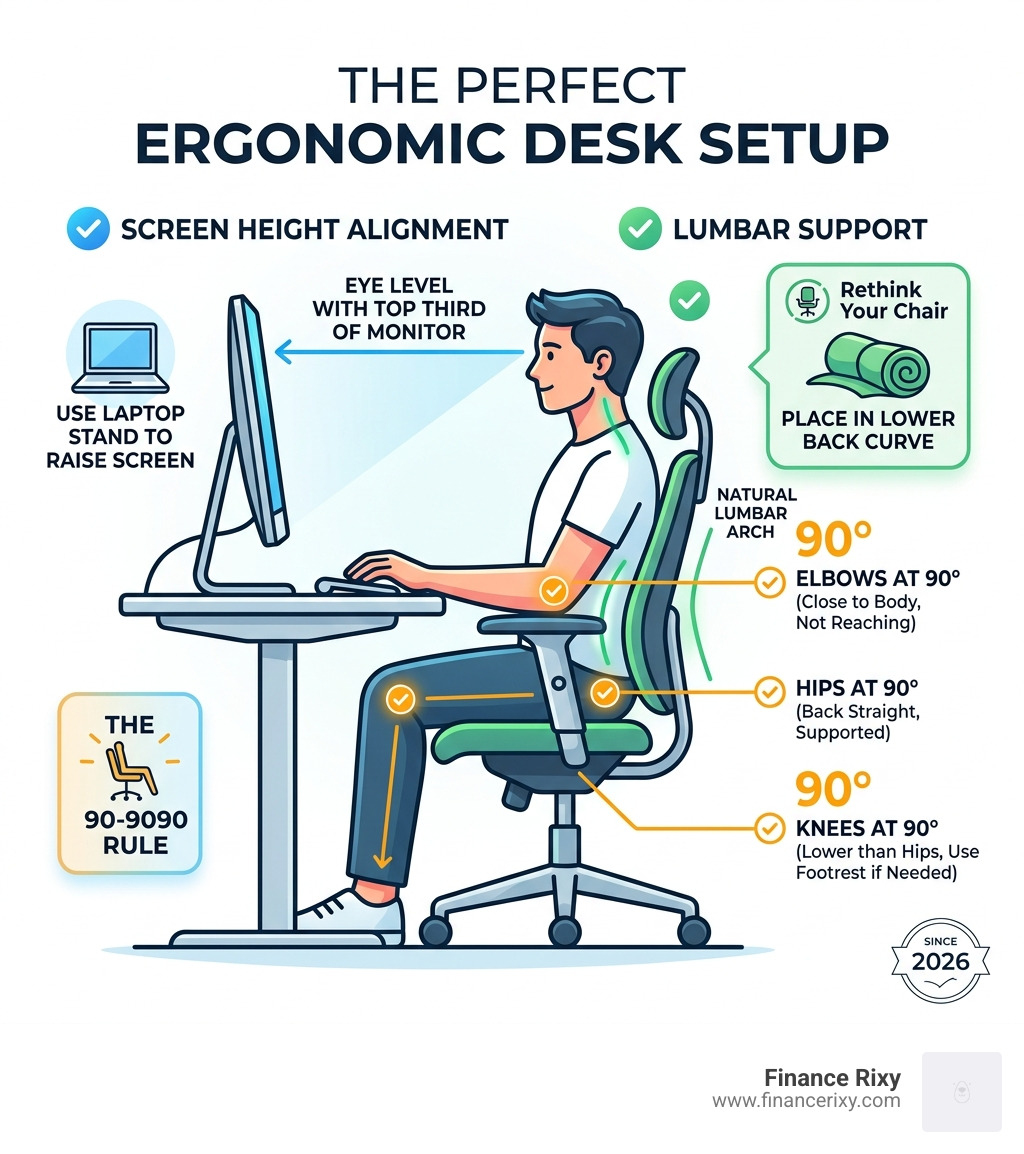
Here are our top ergonomic “hacks” to keep your spine happy:
- The Rolled Towel Method: Many office chairs have “lumbar support” that doesn’t actually fit your back. Take a small towel or a sweatshirt, roll it up, and place it in the curve of your lower back. This maintains the natural lumbar arch.
- Screen Height Alignment: Your eyes should be level with the top third of your monitor. If you’re looking down at a laptop, your neck pulls on your upper back, which eventually strains your lower back. Use a laptop stand or a stack of books!
- The 90-90-90 Rule: Your elbows, hips, and knees should all be at roughly 90-degree angles. Use a footrest if your feet don’t comfortably reach the floor.
- Movement Reminders: Set a “stand up” alarm every 50 minutes. Even a 60-second walk to the water cooler resets your posture.
- Standing Desk Integration: If possible, alternate between sitting and standing. However, standing all day can also cause back fatigue—the “perfect” posture is the next posture. Keep moving!
Frequently Asked Questions about Desk-Related Back Pain
When should I see a doctor for persistent lower back pain?
While stretching helps most people, it isn’t a cure-all. You should consult a healthcare professional if:
- Your pain is chronic, meaning it has lasted for 12 weeks or longer.
- You experience numbness, tingling, or a “pins and needles” sensation in your legs.
- The pain radiates down one leg (sciatica).
- You feel weakness in your feet or legs.
- The pain was caused by a specific trauma or injury.
How often should I perform these stretches during the workday?
We recommend “micro-breaks.” Instead of one long session, try doing one or two stretches every hour. Think of it as a “movement snack.” A 5-minute routine in the morning can wake up your muscles, while an afternoon session can relieve the tension that has built up by 3:00 PM.
What are the most common mistakes to avoid when stretching at a desk?
The biggest mistake is using a wheeled chair for stretches that require stability. If you’re doing a hamstring stretch or a twist, ensure your chair is locked or pushed against a wall so it doesn’t roll away. Additionally, avoid forcing your range of motion. If you can’t touch your toes today, that’s fine—consistency over the next two weeks will get you there.
Conclusion
At Finance Rixy, we believe that your career shouldn’t come at the expense of your physical health. Lower back pain is an incredibly common hurdle, but it is one that can be managed through daily habits and mindful movement.
By incorporating lower back stretches at work, optimizing your desk ergonomics, and listening to your body’s cues, you can build a foundation for long-term mobility. Start small: pick two stretches from this list and do them today. Your spine will thank you.
