
The Best Leg Circulation Desk Moves for Cubicle Athletes
Your Desk Is Quietly Hurting Your Legs — Here’s What to Do
Leg circulation desk moves are simple, discreet exercises you can do without leaving your chair to keep blood flowing through your lower body during long work hours.
Quick answer — the best leg circulation desk moves:
- Ankle pumps — flex and point your feet 15-20 times per leg
- Ankle circles — rotate each ankle 10 times clockwise and counterclockwise
- Seated marching — lift alternating knees for 60 seconds
- Calf raises — rise up on your toes 20 times (seated or standing)
- Leg extensions — straighten one leg, hold 5-10 seconds, then switch
- Toe raises — keep heels down, lift toes repeatedly
- Glute squeezes — squeeze and hold for 5-10 seconds, 15-20 reps
Do these every 30-60 minutes for best results.
Sound familiar? You sit down to work, and a few hours later your legs feel heavy, your feet are puffy, and there’s that dull tingling you can’t quite shake.
That’s not just discomfort. It’s your body signaling that blood is pooling in your lower legs.
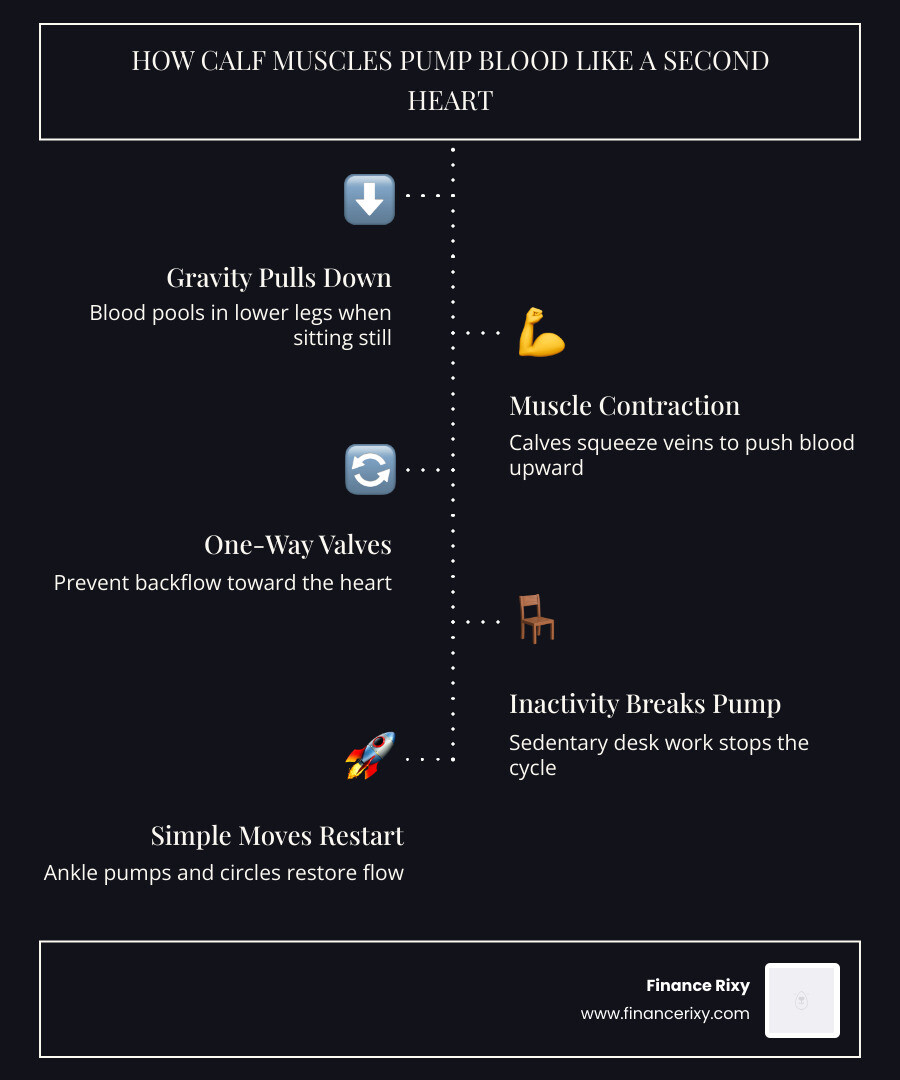
Here’s why it happens: your leg muscles — especially the calves — act like a second heart. Every time they contract, they squeeze blood back up toward your chest. When you sit still for hours, that pumping action stops. Blood slows down. Pressure builds in your veins. Fluid leaks into surrounding tissue.
The result? Swelling, stiffness, fatigue — and over time, real health risks.
The good news is that small, consistent movements make a measurable difference. A Columbia University study found that even just one minute of walking every half hour improves circulation. Five minutes is even better.
You don’t need a gym. You don’t need to leave your desk. You just need to know the right moves.
Why Your Body Needs Leg Circulation Desk Moves
In the modern workplace of April 2026, we often find ourselves tethered to our workstations for eight to ten hours a day. While our brains are sprinting through spreadsheets and emails, our lower bodies are essentially in a state of suspended animation. This inactivity is the primary culprit behind reduced peripheral circulation.
The Struggle of Venous Return
To understand why leg circulation desk moves are so critical, we have to look at the physics of your blood. Your heart is an incredible pump, but it mostly handles the “downhill” trip—sending oxygenated blood out to your extremities. The “uphill” trip—getting deoxygenated blood from your toes back up to your heart—is much harder because it has to fight gravity.
Your veins are equipped with one-way valves to prevent blood from flowing backward. However, veins don’t have thick muscular walls like arteries. They rely on the contraction of surrounding muscles to “squeeze” the blood upward. When we sit still, this “venous return” slows to a crawl.
The “Second Heart” Concept
We often refer to the calf muscles as the “second heart.” When you walk or perform 5 Proven Desk Exercises To Improve Peripheral Circulation In Minutes, your calf muscles contract and act as a mechanical pump. Without this movement, blood begins to pool in the lower legs.
Risks of Prolonged Sitting
Ignoring the need for movement can lead to more than just “heavy legs.” We frequently see the following issues in sedentary workers:
- Edema: This is the medical term for fluid buildup. When blood pools, pressure increases in the veins, forcing fluid into the surrounding tissues of your ankles and feet.
- Varicose Veins: Over time, the pressure from blood pooling can weaken vein walls and damage those one-way valves, leading to swollen, twisted veins.
- Deep Vein Thrombosis (DVT): This is a serious condition where a blood clot forms in a deep vein. It is alarmingly common among middle-aged workers who sit for long periods without breaks.
- Chronic Venous Insufficiency: This occurs when your veins can’t pump enough blood back to the heart, potentially leading to leg ulcers or permanent skin discoloration.
Furthermore, sitting for hours can lead to thickened blood and slower oxygen delivery to your cells. By incorporating leg circulation desk moves, we can maintain better blood viscosity and ensure our tissues stay oxygenated and healthy.
Top 7 Leg Circulation Desk Moves to Do Discreetly
You don’t have to turn your cubicle into a CrossFit box to see results. Many of the most effective leg circulation desk moves are virtually invisible to your coworkers. Whether you’re on a Zoom call or deep in a focus block, these moves keep the “second heart” beating.
1. Ankle Circles
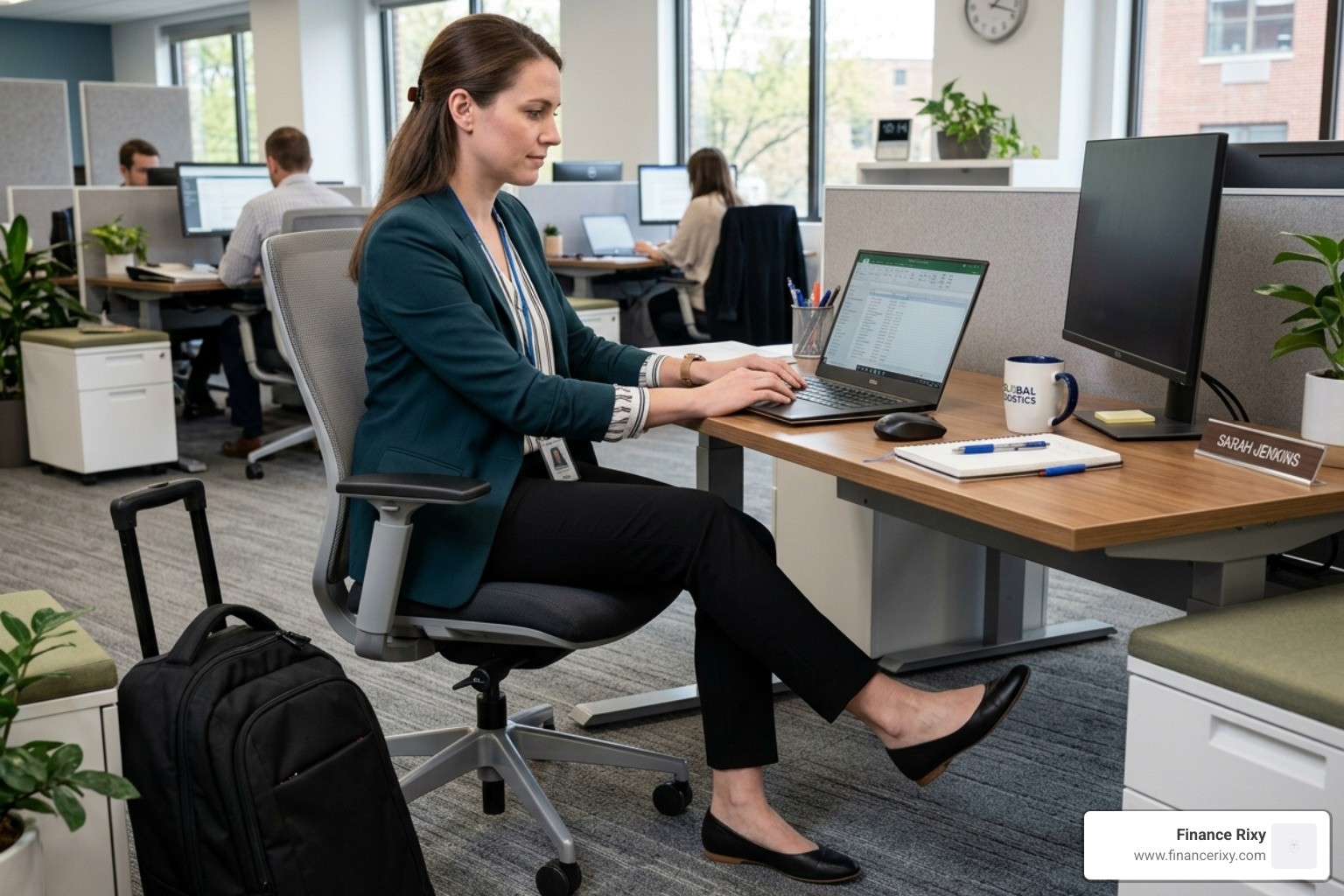
This is the ultimate “stealth” move. While seated, lift one foot slightly off the floor. Rotate your ankle in a slow, controlled circle. Do 10 rotations clockwise and 10 counterclockwise per leg. This movement engages the smaller muscles around the ankle and lower calf, stimulating localized blood flow.
2. Toe Wiggles and Taps
Never underestimate the power of the digits. Rapidly tapping your toes for 30 seconds or simply wiggling them inside your shoes helps encourage micro-circulation in the feet. It’s a great way to wake up “sleepy” feet that have started to feel cold or numb.
3. Glute Squeezes
Your glutes are the largest muscle group in your body, and they effectively “go to sleep” the moment you sit on them. To perform a glute squeeze, simply tighten your buttocks as hard as you can, hold for 5 to 10 seconds, and release. Repeat this 15-20 times. No one will even know you’re doing it, but it helps prevent blood from pooling in the pelvic region and upper thighs.
4. Leg Extensions
Under your desk, straighten one leg out in front of you. Hold it parallel to the floor for 5-10 seconds. You’ll feel the tension in your quadriceps. This move helps stretch the back of the leg while engaging the large thigh muscles to push blood upward. Switch legs and repeat 10 times.
5. Calf Contractions (Heel-Toe Rocks)
While seated with your feet flat on the floor, lift your heels as high as possible while keeping your toes pressed down. Then, reverse it: drop your heels and lift your toes toward the ceiling. This rocking motion is a direct “manual override” for your calf pump.
6. Seated Thigh Squeezes
If you have a small stress ball or even a rolled-up towel, place it between your knees and squeeze. Hold for 5 seconds and release. This engages the inner thigh muscles (adductors), which are often neglected during long bouts of sitting.
7. The “Printer” Calf Raise
Whenever you actually have to stand up—perhaps to grab a coffee or wait for a document at the printer—take that opportunity to do standing calf raises. Rise up onto the balls of your feet, hold for a second, and lower back down. Aim for 20 repetitions.
Seated vs. Standing Movement Benefits
We often get asked if sitting or standing is better. The truth is that movement is the winner in both scenarios.
| Feature | Seated Moves | Standing Moves |
|---|---|---|
| Primary Benefit | Reduces immediate blood pooling | Maximizes gravity-defying blood flow |
| Discretion | High (can do during meetings) | Low (requires standing up) |
| Muscle Engagement | Targeted (ankles, calves) | Full lower body (glutes, quads, calves) |
| Best For | Constant micro-circulation | Resetting posture and “restarting” the pump |
Essential Leg Circulation Desk Moves: The Ankle Pump
The ankle pump is perhaps the most vital tool in our arsenal. It involves two simple motions: flexion (pulling your toes toward your shin) and extension (pointing your toes away like a ballet dancer).
When you perform 20 repetitions of this, you are effectively “milking” the veins in your lower legs. This action creates a pressure gradient that propels blood back toward the heart. We recommend doing these every hour to significantly lower the pressure in your lower leg veins.
Advanced Leg Circulation Desk Moves: Seated Marching
If you have a minute between tasks, seated marching is a fantastic way to get a quick aerobic stimulus without leaving your chair.
- Sit up straight with your core engaged.
- Lift your right knee toward your chest as high as comfortable.
- Lower it and immediately lift the left knee.
- Continue this “marching” motion for 60 seconds.
This move engages the hip flexors and lower abdominals, providing a more robust boost to your systemic circulation than simple ankle movements.
Ergonomic Tools and Lifestyle Habits for Better Blood Flow
While leg circulation desk moves are your first line of defense, your environment plays a massive role in how well your blood moves. A poor desk setup can act like a kink in a garden hose, obstructing flow regardless of how much you wiggle your toes.
The Power of the Footrest
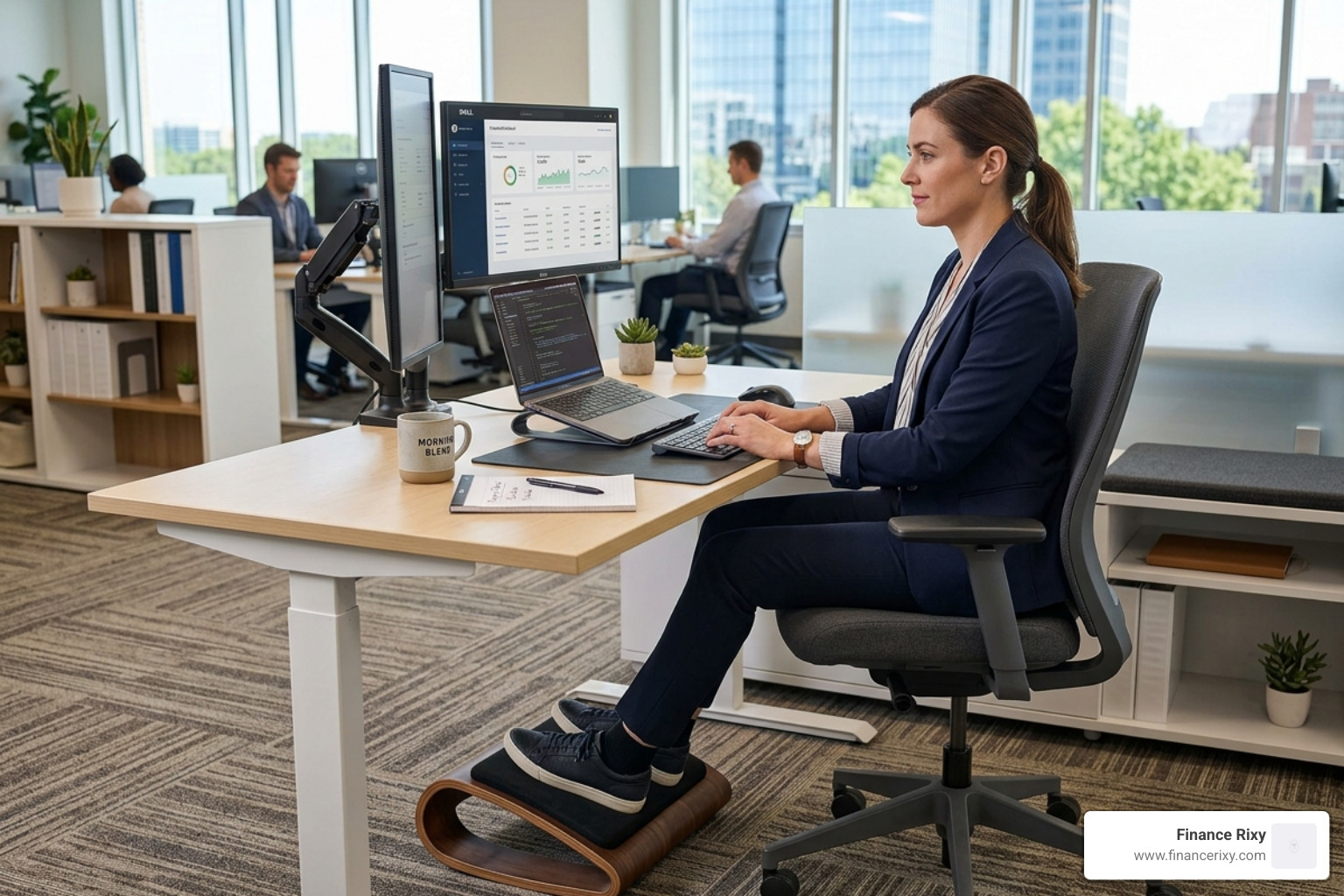
If your feet are dangling or your chair is pressing into the back of your thighs, you are restricting circulation. An ergonomic footrest allows you to keep your feet at an angle that promotes blood flow.
- Rocking Footrests: These are game-changers. They encourage your feet to stay in a constant state of motion, mimicking a walking gait even while you sit.
- Massaging Footrests: Textured surfaces can stimulate pressure points on the feet, which some research suggests has a holistic effect on circulation.
Pedal Exercisers and Under-Desk Ellipticals
For those who want to take their leg circulation desk moves to the next level, under-desk pedal exercisers provide continuous, low-impact motion. These devices allow you to maintain a steady pedaling cadence during phone calls or while reading reports. We suggest starting with 15-20 minutes at low resistance to keep the blood moving without breaking a sweat.
Proper Chair and Desk Setup
According to 4 Ways to Improve Circulation When You’re Stuck at a Desk , your posture is paramount.
- Chair Height: Adjust your chair so your feet rest flat on the floor (or footrest) with your knees at or slightly below hip level.
- The “Waterfall” Edge: Look for chairs with an “edge-free” or “waterfall” seat pan. This rounded front edge prevents the seat from cutting off circulation to the underside of your thighs.
- Standing Desks: While standing desks are great, static standing can be just as hard on your veins as static sitting. The key is to alternate between sitting and standing every 30-60 minutes.
Hydration and Nutrition
Your blood’s ability to circulate is directly tied to its viscosity. If you are dehydrated, your blood becomes “thicker” and harder to pump.
- The Water Rule: Men should aim for about 15 cups of fluid daily, and women about 11 cups. During the workday specifically, try to consume 4-6 cups of water.
- Sodium Reduction: High salt intake causes your body to retain fluid, which can worsen edema (swelling) in the ankles.
When to Seek Professional Medical Advice
While leg circulation desk moves are highly effective for the average worker, they aren’t a substitute for medical treatment if you have an underlying vascular condition. It is important to know the difference between “desk fatigue” and a medical emergency.
Warning Signs You Shouldn’t Ignore
If you consistently experience any of the following, we recommend consulting a vascular specialist:
- Persistent Numbness or Tingling: If “pins and needles” don’t go away after moving, it could indicate nerve compression or significant arterial issues.
- Skin Discoloration: If the skin on your lower legs becomes reddish, bluish, or develops a “stained” brown appearance, this is a sign of chronic venous congestion.
- Cold Extremities: While some people naturally have cold feet, “ice-cold” feet that don’t warm up with movement can be a symptom of Peripheral Artery Disease (PAD).
- Leg Ulcers: Any sore on the leg or foot that is slow to heal requires immediate medical attention.
- Warmth and Redness in One Leg: If one leg is significantly more swollen, red, or warm than the other, this can be a sign of DVT, which is a medical emergency.
Early diagnosis by a professional can prevent long-term complications and help you develop a targeted plan to protect your vascular health.
Frequently Asked Questions about Desk Circulation
How often should I perform these moves for optimal results?
Consistency is the secret sauce. We recommend performing small leg circulation desk moves (like ankle pumps or glute squeezes) every 30 to 60 minutes. Ideally, you should also aim for a “micro-break” every half hour where you stand up and stretch for at least one minute. As the Columbia University study highlighted, these frequent, short bursts of activity are more effective at offsetting the harms of sitting than one long gym session at the end of the day.
What are the common symptoms of poor peripheral circulation?
The most common signs we see are:
- Swollen ankles (Edema): Your socks might leave deep indentations in your skin by 5:00 PM.
- Heavy legs: A feeling of leadenness or fatigue in the lower limbs.
- Tingling or “pins and needles”: Especially in the feet and toes.
- Stiff joints: Difficulty moving your ankles or knees after sitting.
- Visible veins: New or worsening spider veins or varicose veins.
Can a standing desk fix my circulation issues?
A standing desk is a tool, not a cure. If you stand perfectly still for four hours, you are still subjecting your veins to significant gravitational pressure without the help of the “calf pump.” The best approach is “active standing”—shifting your weight from side to side, doing occasional calf raises, or using an anti-fatigue mat that encourages micro-movements of the feet.
Conclusion
At Finance Rixy, we believe that your professional success shouldn’t come at the cost of your physical well-being. Incorporating leg circulation desk moves into your daily routine is one of the simplest and most effective ways to protect your long-term mobility and vascular health.
By waking up your “second heart” with ankle pumps, staying hydrated, and optimizing your workspace ergonomics, you can finish your workday feeling energized rather than exhausted. Your body was built to move—even if your job requires you to stay put.
Take a moment right now: squeeze your glutes, rotate your ankles, and maybe take a quick lap around the office. Your legs will thank you.
