
Crack the Code: The Ultimate Guide to Thoracic Mobility
Why Your Stiff Mid-Back Is the Root of More Problems Than You Think
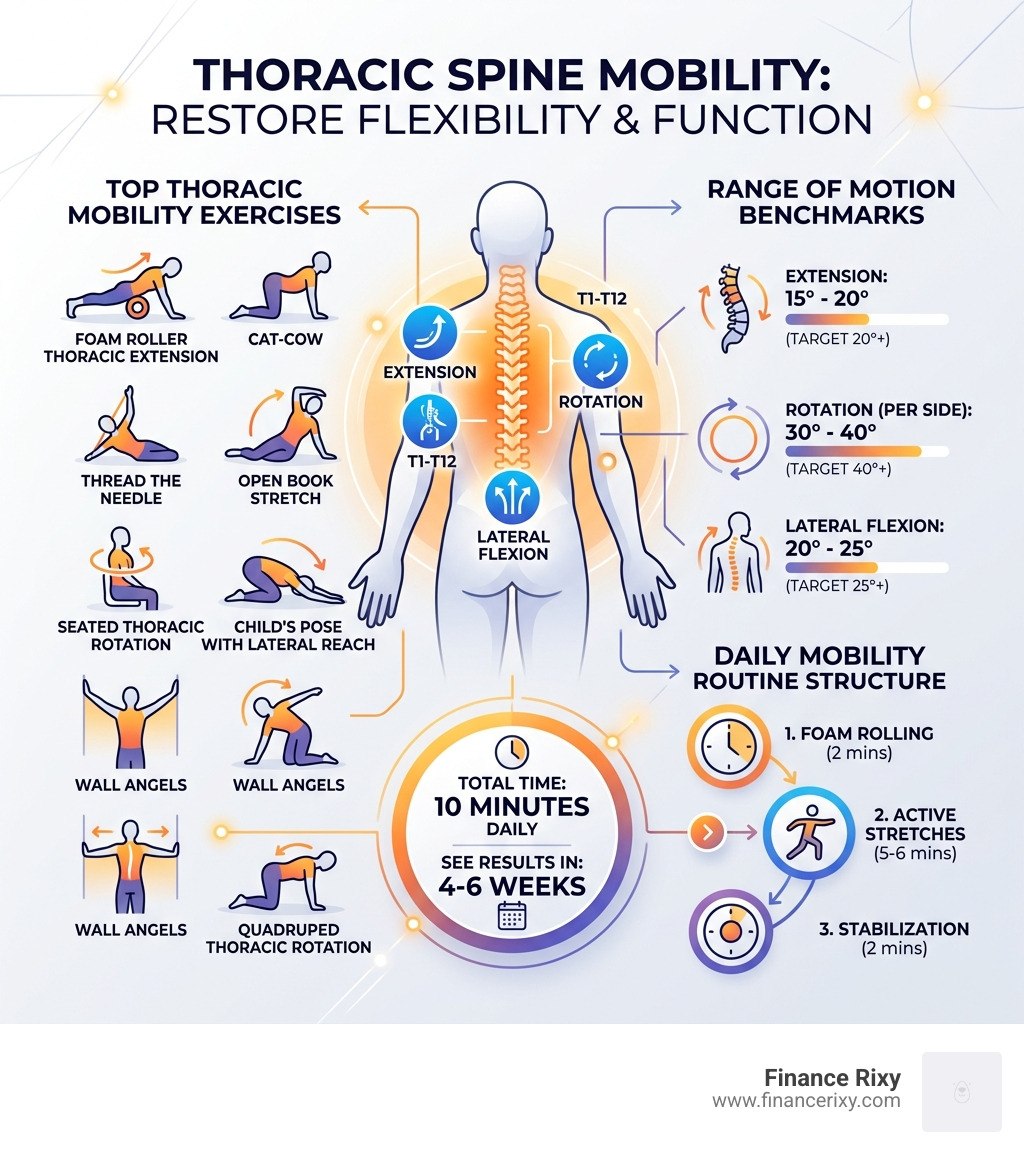
Thoracic spine mobility exercises are targeted movements that restore flexibility, rotation, and extension to the 12 vertebrae (T1-T12) running through your mid and upper back.
The most effective thoracic spine mobility exercises include:
- Foam Roller Thoracic Extension – lie over a foam roller, support your neck, and extend gently over each segment
- Cat-Cow – on hands and knees, alternate rounding and arching your back with your breath
- Thread the Needle – from all fours, slide one arm under your body to rotate the mid-back
- Open Book Stretch – lie on your side, rotate your top arm open toward the floor behind you
- Seated Thoracic Rotation – sit upright, cross arms over chest, rotate slowly side to side
- Child’s Pose with Lateral Reach – extend arms forward and to each side to open the upper back
- Wall Angels – stand against a wall and slide arms overhead while keeping contact with the surface
- Quadruped Thoracic Rotation – on all fours, place one hand behind your head and rotate open
For most people, 10 minutes daily is enough to see real improvement within 4-6 weeks.
Think about how you’re sitting right now. Shoulders rounded forward. Head drifting toward the screen. Lower back doing all the work.
That’s not just bad posture — it’s your thoracic spine slowly losing its ability to move.
The mid-back is designed for rotation and extension. But hours at a desk, hunching over a phone, or slouching on the couch gradually steal that range of motion. And when the thoracic spine stops moving well, the joints above and below it — your neck, shoulders, and lower back — are forced to pick up the slack.
That’s where the pain starts.
As one physical therapy expert put it, the thoracic spine is often the “neglected middle child of the spine” — overlooked until everything around it starts hurting.
The good news? It responds quickly to consistent, targeted movement.
Why Thoracic Spine Mobility Exercises Are Essential for Performance
When we talk about the thoracic spine (the T1-T12 region), we are looking at the foundational anchor for your rib cage. Because this section of the spine is physically attached to your ribs, it is naturally more stable than your neck (cervical) or lower back (lumbar). However, “stable” shouldn’t mean “stuck.”
In the fitness world, we often follow the “Joint-by-Joint” approach. This theory suggests that the body is a stack of joints that alternate between needing stability and needing mobility. Your ankles need mobility, your knees need stability, your hips need mobility, and your lumbar spine needs stability. According to this logic, your thoracic spine must be mobile. If it isn’t, your body will “steal” that movement from the lower back or the neck, leading to chronic aches and potential injury.
The Overhead Connection
If you’ve ever struggled with an overhead press or felt a pinch in your shoulder during a snatch, your mid-back might be the culprit. Research shows that approximately 15 degrees of thoracic spine extension is required for full overhead motion, such as a barbell overhead press. If you’re performing a one-arm elevation, you still need about 9 degrees of extension.
Without this extension, your shoulder blades (scapulae) cannot tilt correctly. This reduces the sub-acromial space in the shoulder joint, which can lead to bicep tendon impingement and rotator cuff irritation. Essentially, Thoracic Spine Exercise: Improve Mobility and Strength isn’t just about the back; it’s about saving your shoulders. Experts like Eric Cressy have noted that 13-15 degrees of thoracic extension is required just to reach full shoulder flexion.
Breathing and Posture
Beyond the gym, a stiff thoracic spine traps you in a state of “kyphosis”—that rounded, hunchback look we all dread. This forward slump compresses the chest, making it harder for your diaphragm to expand. By performing 5 Exercises for Thoracic Mobility [UPDATED] – Movement Enhanced, you open up space for the lungs and heart, improving your breathing capacity and reducing the “stress” signals your body sends when it can’t take a full breath.
Assessing Your Mid-Back: How to Test Mobility at Home
Before we dive into the thoracic spine mobility exercises, we need to know where you stand. You wouldn’t try to fix a car without checking the engine first, right?
The Rotation Test
Rotation is the primary movement of the thoracic spine. To test yours:
- Sit on your heels (quadruped position).
- Place one forearm on the ground in front of you and the other hand behind your head.
- Rotate your elbow toward the ceiling without letting your hips shift.
- The Goal: You should be able to achieve 50 degrees of rotation in each direction (measured by the angle of your shoulders relative to the floor). If you’re hitting less than 35 degrees, you’ve got some work to do!
The Wall Angel Assessment
Stand with your back against a wall, heels about 6 inches away. Try to flatten your lower back against the wall. Now, bring your arms up into a “goalpost” position, keeping your elbows and the backs of your hands touching the wall. Slide them up into a “Y” shape.
- The Fail: If your lower back arches off the wall or your hands lift away, your thoracic spine is likely restricted, and your body is using “lumbar compensation” to fake the movement.
| Range of Motion | Normal/Goal | Restricted |
|---|---|---|
| Thoracic Rotation | 50° each side | < 35° each side |
| Thoracic Extension | 15° for overhead | < 10° (rib flare occurs) |
| Wall Angel | Hands/Back flat | Hands lift/Back arches |
Top 10 Thoracic Spine Mobility Exercises for Daily Relief
Now for the main event. These thoracic spine mobility exercises are designed to hit the three planes of motion: flexion/extension, rotation, and lateral flexion.

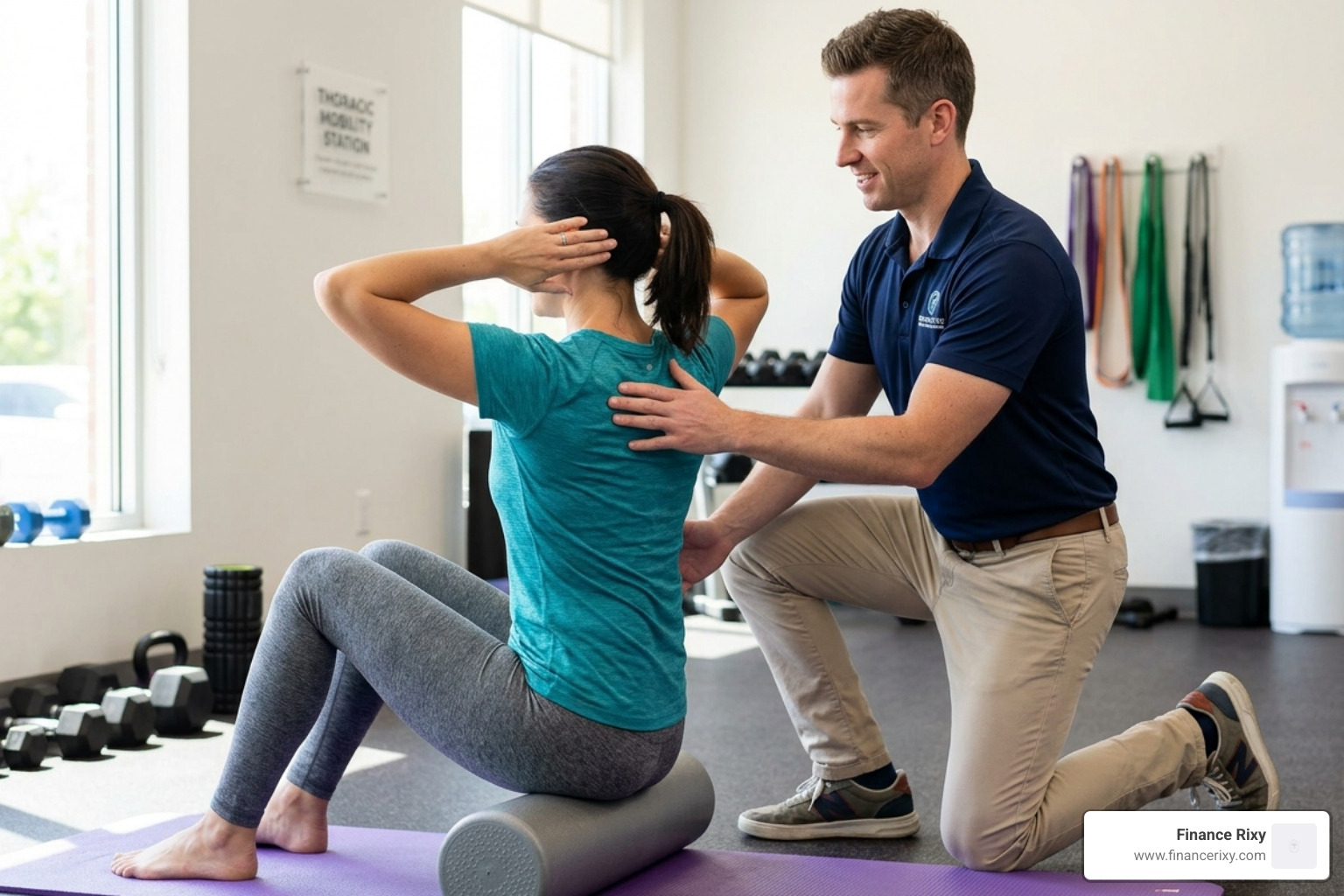
- Foam Roller Extension: This is the gold standard. Place the roller under your mid-back (never the lower back!). Support your head with your hands, keep your butt on the floor, and gently lean back over the roller. Exhale as you extend to help the ribs “knit” down, preventing your lower back from doing the work.
- Cat-Cow: A classic for a reason. On all fours, inhale as you drop your belly and look up (Cow), then exhale as you tuck your chin and round your spine like an angry cat. Focus on moving the segment between your shoulder blades.
- Thread the Needle: This is a fan favorite from 8 Thoracic Mobility Exercises to Improve Function and Form. From all fours, reach one arm under your body, resting your shoulder on the floor. It provides a deep, satisfying stretch across the upper back.
- Open Book Stretch: Lie on your side with your knees tucked to your chest (this “locks” the lower back). Reach your top arm across to the other side, following your hand with your eyes.
- Bench T-Spine Mobilization: Kneel in front of a bench or chair. Place your elbows on the edge and hold a PVC pipe or broomstick. Sink your chest toward the floor. This is incredible for opening up the lats and the upper back simultaneously.
- Spiderman with Rotation: Step into a long lunge, placing both hands inside your front foot. Take the hand closest to the front foot and reach it toward the sky, rotating through the mid-back.
- Seated Rotation: Perfect for the office. Sit tall, cross your arms, and rotate your torso as far as you can without moving your hips. Hold for 30 seconds.
- Wall Angels: Use the assessment as an exercise! Perform 10-12 slow reps, focusing on keeping the rib cage down and the back flat.
- Child’s Pose with Lateral Reach: From a standard Child’s Pose, walk your hands to the left to stretch the right side of your back, then switch. This addresses lateral flexion restrictions.
- Quadruped Thoracic Rotation: On all fours, hand behind the head, touch your elbow to your opposite wrist, then rotate it toward the sky.
Beginner-Friendly Thoracic Spine Mobility Exercises
If you are just starting out or currently dealing with significant stiffness, don’t force the big movements. Start with these “desk-side” interventions:
- Seated Pec Stretch: Stiffness in the chest often pulls the thoracic spine into a rounded position. Stretch the pecs to allow the spine to stand tall.
- Scapular Squeeze: Simply sitting tall and squeezing your shoulder blades together for 5 seconds can “wake up” the rhomboids and middle trapezius.
- Chair-Based Extensions: If you’re at work, use the top of your chair as a fulcrum to perform a mini-extension. Just make sure the chair is sturdy! You can find more gentle variations in this Improve Thoracic Spine Mobility (4 Best Exercises) – YouTube guide.
Advanced Thoracic Spine Mobility Exercises for Athletes
For the fitness athletes among us, we need to “lock in” our mobility with stability and load.
- Kettlebell Windmill: This requires massive thoracic rotation and stability under load.
- Barbell Opener: A favorite for those chasing a better overhead squat. Using a barbell provides “overpressure” that helps sink into the stretch.
- Band-Loaded Rotations: Adding a resistance band to your quadruped rotations creates “neurological demand,” teaching your brain how to control the new range of motion you’ve just unlocked.
Building Your Routine: Frequency and Best Practices
To see results, you need a plan. At Finance Rixy, we believe that small, daily habits beat one-off “marathon” sessions every time.
The 10-Minute Sequence:
- Minutes 1-3: Foam Roller Extensions (Activation)
- Minutes 4-7: Cat-Cow and Thread the Needle (Movement)
- Minutes 8-10: Wall Angels or Spiderman Rotations (Integration)
Equipment Needs
You don’t need a full gym. A medium-density foam roller is the most impactful tool you can own. A “peanut ball” (two tennis balls taped together) is also great for targeting the muscles right next to the vertebrae. Resistance bands and a firm-backed chair can round out your toolkit.
Key Tips for Form
- Breathe: Always exhale into the stretch. This allows the rib cage to descend and the spine to move further.
- Engage the Core: Think “ribs to hips.” If your rib cage flares out, you aren’t extending your thoracic spine—you’re just arching your lower back.
- Follow Your Eyes: In rotation drills, your head should follow your hand. This ensures the cervical and thoracic spine move in unison.
Frequently Asked Questions about Thoracic Mobility
How often should I perform thoracic mobility drills?
Daily consistency is the secret sauce. While 3-5 times per week can produce meaningful improvement within 4-6 weeks, a quick 10-minute daily session is the fastest way to reverse years of desk-bound stiffness. Think of it like brushing your teeth—it’s hygiene for your spine.
Can a stiff mid-back cause lower back pain?
Absolutely. This is the “Joint-by-Joint” theory in action. If your mid-back won’t rotate, your lower back (lumbar) will try to do it for you. However, the lumbar spine is only designed for about 5 degrees of rotation per segment. Forcing it to rotate leads to disc issues and muscle strains. Hinge Health data shows that members experience an average 68% reduction in pain when incorporating these mobility drills, precisely because it takes the pressure off the lower back.
Is it safe to “pop” my back while stretching?
That audible “pop” is called cavitation—it’s just gas being released from the synovial fluid in your joints. It’s generally harmless and often feels like a relief. However, you should never force a pop. Let it happen incidentally during gentle, controlled movements. If a pop is accompanied by sharp pain, stop immediately and consult a professional.
Conclusion
Cracking the code to a pain-free life often starts in the middle of your back. By incorporating thoracic spine mobility exercises into your daily life, you aren’t just improving your posture; you’re unlocking your body’s full potential for movement, breathing, and performance.
At Finance Rixy, we know that wellness isn’t about one big change—it’s about the small breaks and stretches you take throughout the day. Whether you’re an athlete chasing a PR or an office worker just trying to get through the day without a headache, your thoracic spine is the key.
Ready to take your physical well-being to the next level? Improve your well-being with Finance Rixy and start building the habits that lead to long-term health. Stand up, stretch out, and let your spine breathe!
