
Top Rated Deskercises to Keep You Moving While You Work
Why Your Body Craves the Best Stretches for Sitting at Desk
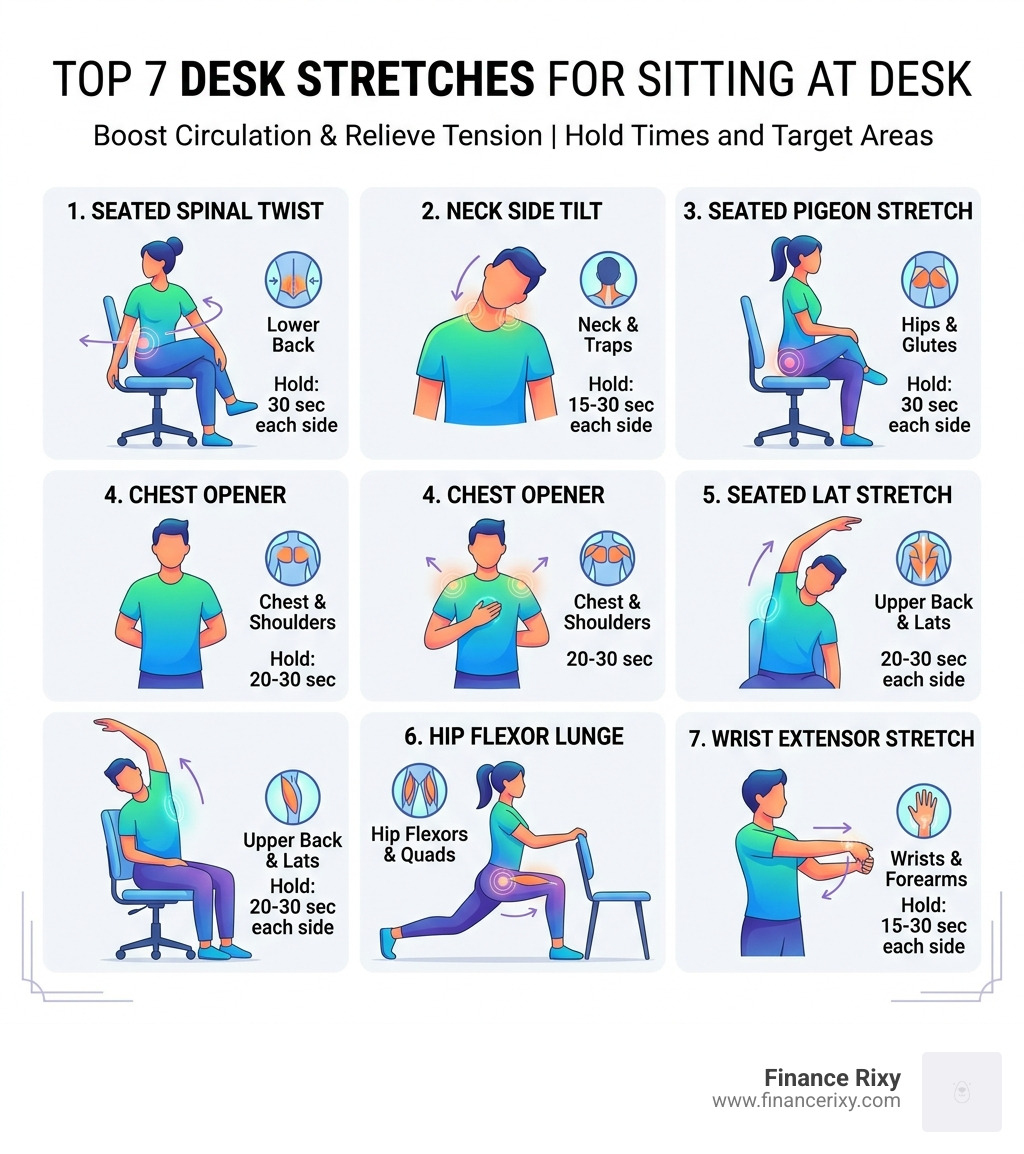
The best stretches for sitting at desk workers include these quick, effective moves you can do right now:
| Stretch | Target Area | Time Needed |
|---|---|---|
| Seated spinal twist | Lower back | 30 sec each side |
| Neck side tilt | Neck and traps | 15-30 sec each side |
| Seated pigeon stretch | Hips and glutes | 30 sec each side |
| Chest opener | Chest and shoulders | 20-30 sec |
| Seated lat stretch | Upper back and lats | 20-30 sec each side |
| Hip flexor lunge | Hip flexors and quads | 30-60 sec each side |
| Wrist extensor stretch | Wrists and forearms | 15-30 sec each side |
Here’s something worth pausing for: how are you sitting right now?
Chances are your shoulders are rounding forward, your hips are tight, and your neck is craning toward your screen. You’re not alone. With many Americans spending eight or more hours a day at a desk, the physical toll adds up fast.
Prolonged sitting causes muscles to shorten and tighten — especially in your hip flexors, neck, and upper back. Research has linked long stretches of sitting to increased cardiovascular risk and a shorter life span. Even your posture quietly suffers, placing extra stress on your spine with every hour you stay still.
The good news? You don’t need a gym, special equipment, or even a sweat session to fix it. A few simple stretches — done right at your desk — can make a real difference in how you feel by the end of the day.
The Science of the “Stuck” Feeling
As we move through April 2026, the data on sedentary lifestyles is clearer than ever. When we stay in one position for hours, our blood flow slows down and our joints lose their extensibility. This lack of stimulation leads to the “desk job trifecta”: soreness, fatigue, and cramping.
One of the biggest culprits is muscle shortening. Your hip flexors (the muscles that help you lift your legs) are kept in a shortened state while you sit. Over time, they stay that way, pulling on your lower back and causing that familiar ache when you finally stand up. Meanwhile, your glutes and core essentially “go to sleep,” leaving your spine without the support it needs.
Stretching acts as a “reset button.” It teaches your body that movement is safe and healthy, which can actually change how your brain interprets pain signals. Plus, just ten minutes of stretching a day can counteract the effects of inactivity by significantly improving flexibility.
10 Essential Deskercises for Daily Relief
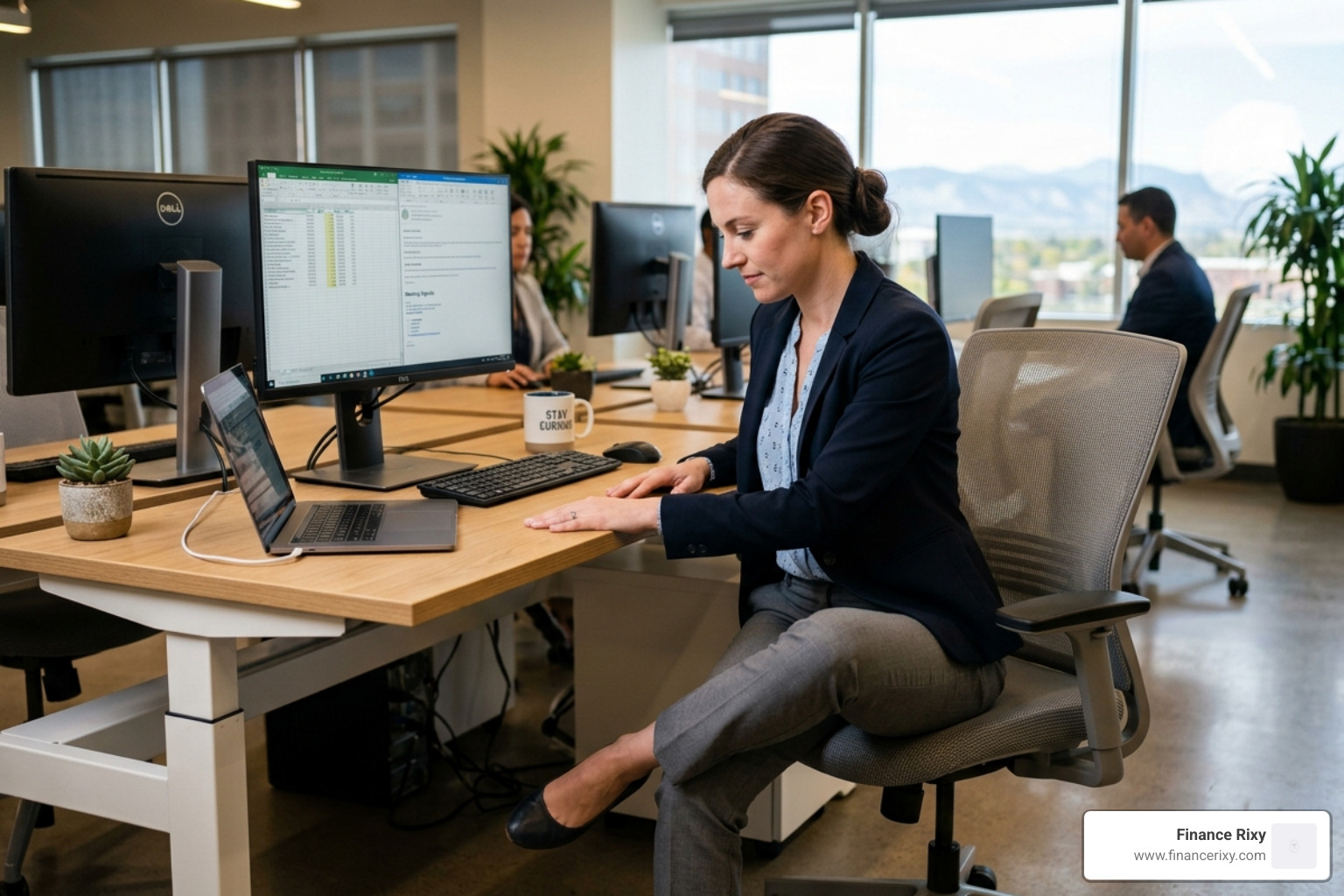
To keep your body happy, we recommend a mix of seated and standing moves. You can even do many of these during a conference call — no one will even know! Here are the best stretches for sitting at desk relief.
1. Seated Pigeon Stretch
This is a powerhouse move for opening up your hips and glutes. While seated, cross your right ankle over your left knee. Keep your back straight and gently lean forward until you feel a stretch in your right hip. Hold for 30 seconds and swap.
2. Seated Lat Stretch
Your “lats” (the large muscles in your back) get incredibly tight from reaching for a keyboard. Reach your arms overhead, grab your right wrist with your left hand, and lean to the left. This opens up the side of your body and reduces shoulder tension.
3. Shoulder Shrugs
Simple but effective. Lift your shoulders up toward your ears as hard as you can, hold for a second, and then drop them down, feeling the tension melt away. Repeat this 10 times in each direction (rolling forward and then backward).
4. Neck Tilts and Turns
To combat “tech neck,” slowly tilt your ear toward your shoulder without lifting the shoulder itself. You can also perform “head turns,” looking over your shoulder as if you’re backing up a car. For a deeper dive into these movements, check out this Desk stretches video collection from the Mayo Clinic.
5. Chest Opener (Doorway Stretch)
Stand in a doorway or use the back of your chair. Place your forearms on the frame and gently lean forward. This reverses the “hunch” we all get from staring at monitors and opens up the pectoral muscles.
6. Wrist Extensor Stretch
If you type or text all day, your forearms are likely screaming for help. Extend one arm in front of you, palm down, and use your other hand to gently pull your fingers toward your body.
7. Seated Spinal Twist
Sit tall with your feet flat. Place your left hand on your right knee and your right hand on the back of your chair. Gently twist to look over your right shoulder. This provides vital rotation for your spine.
8. Standing Calf Stretch
Stand and place your hands on your desk for balance. Step one foot back, keeping the heel on the floor and the leg straight. This improves blood flow in the lower legs and helps prevent that “heavy leg” feeling.
9. Chair Hamstring Reach
Sit on the edge of your chair and extend one leg out straight with your heel on the floor. Lean forward from the hips (keep your back flat!) until you feel a stretch in the back of your thigh. Avoid doing both legs at once, as this can strain your lower back.
10. Hip Flexor Lunge
Stand up and take a big step forward with one foot. Lower your back knee slightly and tuck your tailbone under. You should feel a deep stretch in the front of the hip of your back leg. This is the ultimate “anti-sitting” move.
Best Stretches for Sitting at Desk: Upper Body Focus
The upper body often carries the brunt of work-related stress. We tend to hold tension in our upper traps and jaw, leading to headaches.
- Triceps Stretch: Reach one arm overhead and drop the hand behind your neck. Use the other hand to gently push the elbow down.
- Overhead Reach: Interlace your fingers and push your palms toward the ceiling. This lengthens the spine and intercostal muscles (between your ribs).
- Rhomboid Stretch: Interlace your fingers in front of you and push your hands away while rounding your upper back. This targets the muscles between your shoulder blades.
- Chin Tucks: Gently pull your chin straight back (making a “double chin”). This aligns your head over your spine and relieves the strain on your neck.
For a structured routine focusing on these areas, you might enjoy The Ultimate Deskercise Routine which breaks down these movements into manageable sets.
Best Stretches for Sitting at Desk: Lower Body and Core
Don’t forget the “powerhouse” of your body. When your core and lower body are stiff, everything else has to work harder.
- Seated Glute Sets: This is a “stealth” exercise. Simply squeeze your glutes as hard as you can while sitting, hold for five seconds, and release. It wakes up the muscles that go dormant while sitting.
- Ankle Rolls: Lift your feet and roll your ankles in circles. This helps with circulation and prevents stiffness in the lower extremities.
- Sit-to-Stands: Use your chair for bodyweight squats. Stand up without using your hands, then slowly sit back down. Do 10 of these to get your heart rate up and your legs moving.
- Pelvic Tilts: While seated, imagine your pelvis is a bowl of water. Tilt it forward to arch your back, then tilt it back to flatten your spine against the chair.
How to Build a Sustainable Stretching Routine
We know you’re busy. The key to making these habits stick isn’t about finding a 60-minute window; it’s about “movement snacks.”
| Feature | Dynamic Stretching | Static Stretching |
|---|---|---|
| What is it? | Moving through a range of motion | Holding a position |
| Best for… | Getting blood flowing mid-work | Deepening flexibility |
| Duration | 15-20 repetitions | 30-60 second hold |
| Effort | Active and energizing | Relaxing and calming |
The “Movement Snack” Concept
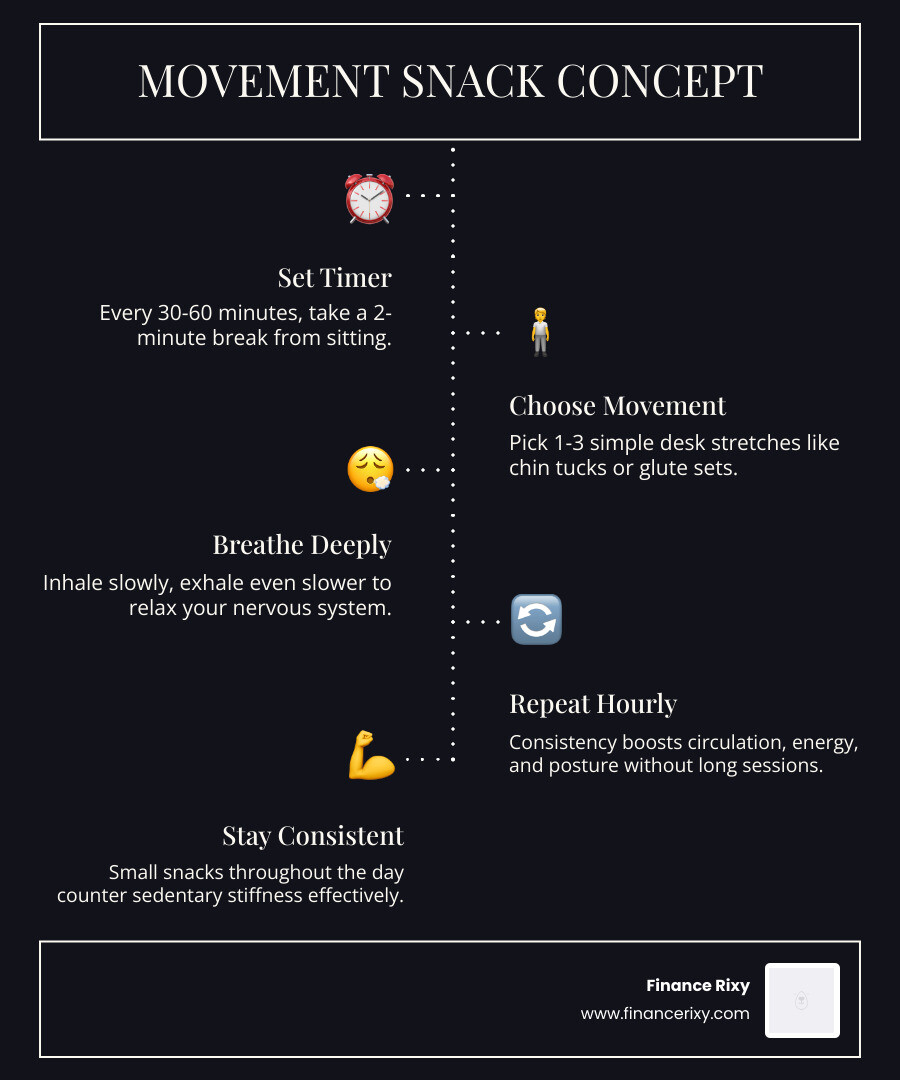
Instead of one long session, try to move once every hour. This could be as simple as standing up during a phone call, walking to the farthest water cooler, or doing three minutes of stretches while the coffee brews.
Breathing is your secret ingredient. Never hold your breath while stretching. Instead, take slow inhales and even slower exhales. This signals your nervous system to relax, making the stretch more effective and helping you refocus on your tasks.
Ergonomics and Safety
Before you start your routine, check your environment:
- Chair Setup: Sit all the way back in your chair with your feet flat on the floor.
- Monitor Height: Your screen should be at eye level so you aren’t looking down.
- Listen to Your Body: Stretch to the point of “mild interest” or tension — never pain. If it hurts, back off.
- Stability: If you’re using your chair for support, make sure it isn’t a rolling chair, or at least ensure it’s pushed against a wall.
Frequently Asked Questions about Desk Stretches
How often should I stretch during the workday?
At a minimum, we recommend stretching every two hours. However, the “gold standard” is to move every hour. Even a 60-second break to do some shoulder shrugs and ankle rolls can prevent the cumulative stiffness that leads to end-of-day pain. A 10-15 minute daily routine is ideal for long-term mobility.
Can I do these stretches without special equipment?
Absolutely! These are “no-sweat” exercises designed for the office. Your chair, a doorway, or even your desk itself are the only “props” you need. You don’t need yoga pants or a mat to find relief from the best stretches for sitting at desk work.
What is the best stretch for lower back pain?
Lower back pain is often a symptom of tight hip flexors and a stiff thoracic spine. We recommend the Seated Spinal Twist to mobilize the vertebrae and the Hip Flexor Lunge to release the tension pulling on your pelvis. Combining these with core engagement (like pelvic tilts) provides the best results. For more ideas on counteracting the effects of a long day, see these 7 Easy Stretches to Counteract Sitting All Day.
Conclusion
At Finance Rixy, we believe that small, daily habits lead to massive changes in your long-term health. You don’t have to choose between a productive career and a body that feels good. By incorporating these “deskercises” into your routine, you’re taking a proactive step toward better posture, increased energy, and a pain-free workday.
Ready to take your physical well-being to the next level? Start with just one movement snack today and feel the difference. For more targeted advice on mobility and wellness, Improve your well-being with Finance Rixy.
