
The Only Ankle Circle Mobility Drill You Need for Healthy Joints
Why Your Ankles Are the Foundation of Pain-Free Movement
The ankle circles mobility drill is one of the simplest, most effective exercises you can do for joint health — and you can do it right at your desk.
Quick answer: How to do ankle circles
- Sit in a chair with your feet flat on the floor
- Lift one foot a few inches off the ground
- Slowly rotate your ankle clockwise for 10-15 reps
- Reverse direction for 10-15 reps counterclockwise
- Switch feet and repeat
- Aim for 2-3 sets per foot
No equipment needed. Takes under 3 minutes.
Most of us sit for hours every day. That stillness quietly stiffens the ankle joint, tightens the surrounding tendons, and chips away at your range of motion — often without you noticing until something hurts.
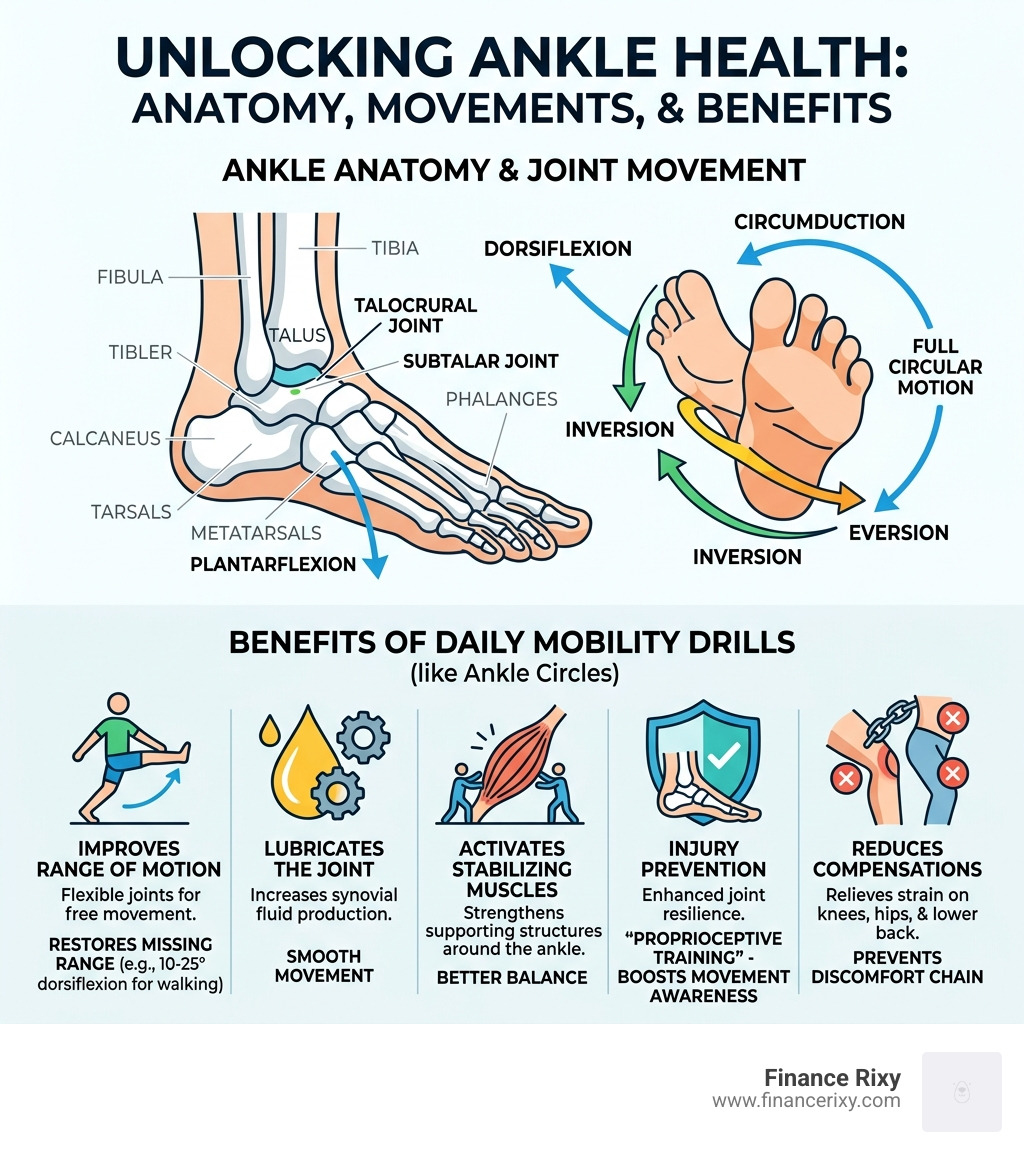
Your ankle needs roughly 10-25 degrees of dorsiflexion just to walk normally. When that range shrinks, your body compensates. Knees, hips, and lower back all start picking up the slack. The result? A slow chain of discomfort that starts at the floor and works its way up.
The good news: ankle circles directly address this. They lubricate the joint, activate the stabilizing muscles, and restore the range of motion that desk life slowly steals.
This guide will show you exactly how to do them right — and how to make them stick.
Why the Ankle Circles Mobility Drill is Essential for Longevity
At Finance Rixy, we believe that longevity starts from the ground up. In April 2026, as more of us embrace hybrid work environments, the health of our foundation—the ankles—has never been more critical. The ankle circles mobility drill isn’t just a warm-up; it’s a vital tool for long-term physical well-being.
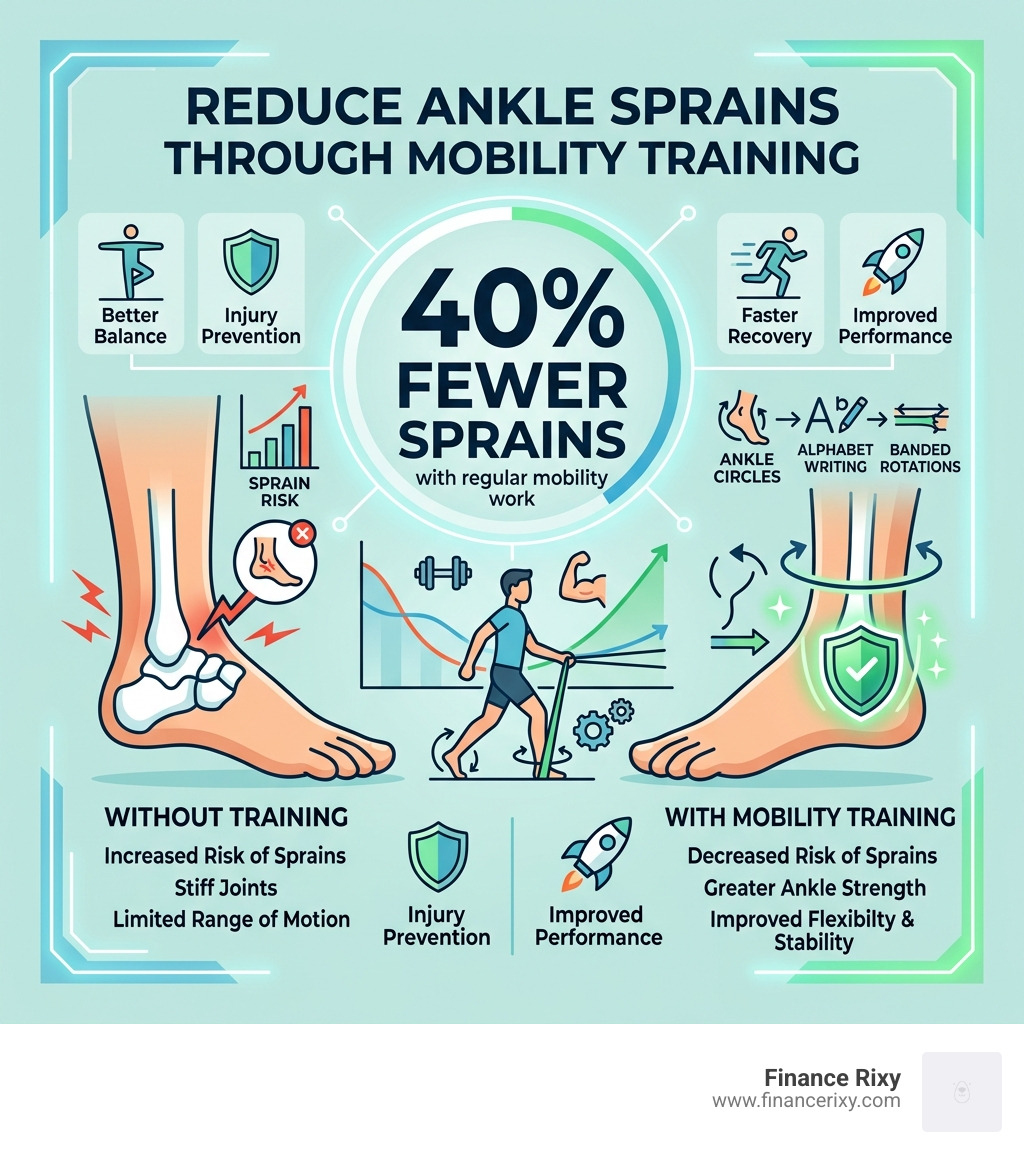
One of the primary reasons we advocate for this drill is injury prevention. Enhanced ankle mobility can decrease the likelihood of ankle sprains and other related injuries by up to 40%. When you move your ankle through its full range of motion, you are engaging in proprioceptive training, which helps your brain better understand where your foot is in space. This “movement awareness” is what prevents you from rolling your ankle when you step off a curb or navigate uneven terrain.
Furthermore, this drill helps circulate synovial fluid. Think of this fluid as the “oil” for your hinges. Moving the joint regularly keeps it lubricated, reducing the stiffness that leads to conditions like plantar fasciitis, which currently affects up to 10% of people. For those who wear high heels or restrictive dress shoes, ankle circles provide much-needed relief by countering the constant state of plantarflexion (toes pointed down) that these shoes enforce.
As we look at the requirements for daily life versus high-level activity, the importance of a “ground-up” approach becomes clear:
| Activity | Required Dorsiflexion (Degrees) |
|---|---|
| Normal Daily Walking | 10–25° |
| Deep Squatting | ~35° |
| Athletic Landing/Jumping | 35°+ |
If you can’t hit these numbers, your body will find the movement elsewhere—usually by stressing your knees or lower back.
How to Perform the Ankle Circles Mobility Drill with Perfect Form
To get the most out of the ankle circles mobility drill, we need to focus on isolation. The goal is to move the ankle joint without letting the rest of the leg join the party. This exercise primarily involves the Tibiotalar Joint (where your shin meets your foot) and the Subtalar Joint (responsible for side-to-side tilting).
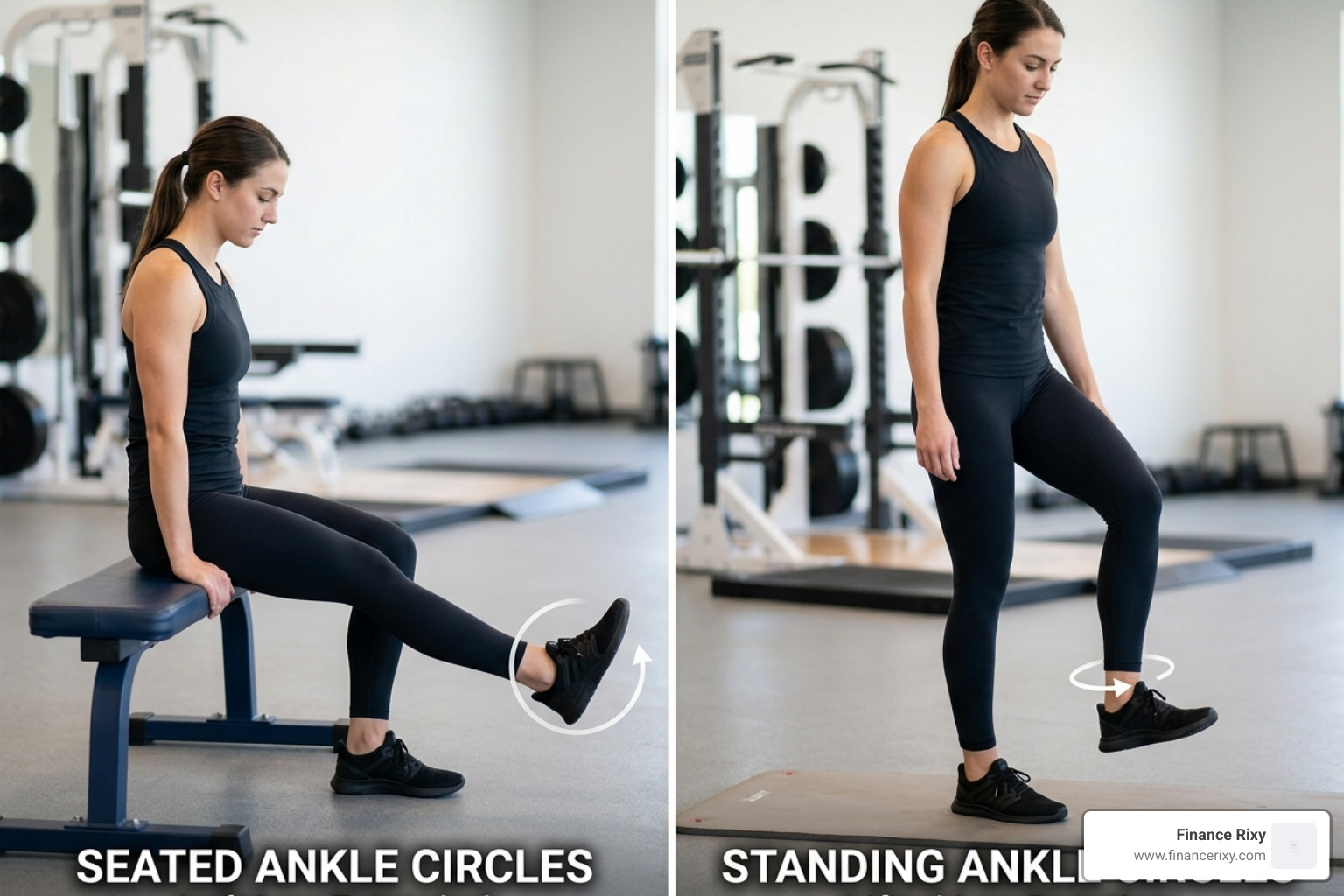
Follow this step-by-step guide to ankle circles to ensure you are hitting the full active range of motion:
- The Setup: Sit tall in a chair or stand with one hand on a wall for support. If seated, extend one leg out. If standing, lift one foot slightly off the floor.
- The Starting Point: Point your toes forward and relax the foot.
- The 3-0-3 Tempo: This is our secret weapon for control. Spend 3 seconds moving through the first half of the circle, 0 seconds pausing, and 3 seconds finishing the circle. Rushing ruins the benefit!
- Clockwise Rotations: Imagine your big toe is a pen. Draw the largest circle possible. At the top of the circle, pull your toes toward your shin (dorsiflexion). On the way down, sweep to the outside (eversion).
- Counter-Clockwise Rotations: Reverse the movement. As you sweep toward the inside, you are practicing inversion.
- Switch and Repeat: Complete 10–15 controlled reps per direction on each foot.
Common Mistakes in the Ankle Circles Mobility Drill
Even a “simple” drill can be done incorrectly. We often see these six common errors:
- Knee Compensation: If your kneecap is wobbling left and right, you aren’t working your ankle; you’re working your hip. Keep the leg still.
- Rushing Repetitions: Fast circles use momentum rather than muscle control. Slow down to engage the stabilizers.
- Momentum Usage: Don’t let the foot “flop” through the bottom of the circle. Maintain tension throughout.
- Breath Holding: It’s just an ankle circle, but we often hold our breath when focusing. Keep your breathing deep and steady.
- Hip Rotation: Similar to the knee, your thigh should not be rotating in the socket.
- Standing Knee Lockout: If you are doing these standing, keep a “soft” micro-bend in your supporting knee to protect the joint and improve balance.
Assessing Progress Before and After Your Drill
How do you know if your ankle circles mobility drill is actually working? In April 2026, the gold standard for at-home assessment is the Weight-Bearing Lunge Test.
To do this, stand facing a wall with your big toe about 4 inches (10 cm) away. Try to touch your knee to the wall without letting your heel lift off the ground. If you can do it easily, move your foot back an inch and try again. If your heel pops up or your knee can’t reach, that’s your current limit.
We want to see you move toward that 35-degree dorsiflexion mark, which is roughly 5 inches of clearance from the wall for most adults. By tracking this every few weeks, you can distinguish between “flexibility” (how far someone can push your foot) and “mobility” (how far you can move your foot yourself).
Variations and Progressions for Every Fitness Level

Once you’ve mastered the basic version, it’s time to level up. Variety is the spice of joint health!
- Alphabet Writing: Instead of circles, use your big toe to “write” the capital letters of the alphabet in the air. This forces the ankle into complex angles it doesn’t usually hit.
- Ball of Foot Circles: This is often called the “mother of all foot drills.” Keep your toes on the ground but lift your heel. Rotate the ankle so the “ball” of the foot stays put while the heel carves out a circle. This targets the midfoot joints beautifully.
- Resistance Bands: Loop a mini-band around your feet. As you perform the circle, the band provides resistance, turning a mobility drill into a strengthening exercise for the peroneals and tibialis muscles.
- Senior Safety Modification: If balance is a concern, perform these seated with the calf resting on a rolled-up towel. This supports the leg and allows you to focus entirely on the ankle range of motion.
For a visual walkthrough, you can check out this video demonstration of ankle rotations to ensure your path of motion is correct.
Advanced Progressions of the Ankle Circles Mobility Drill
For the athletes and “mobility nerds” among us, these advanced tweaks will challenge your nervous system:
- Eyes-Closed Training: Removing visual input forces your brain to rely entirely on proprioception. This is an incredible way to build balance.
- Eccentric Control: Focus on a very slow 5-second descent during the “pointing down” phase of the circle.
- Banded Talocrural Glides: Use a heavy resistance band anchored behind you, looped over the “crook” of your ankle. As you move into dorsiflexion, the band helps pull the talus bone back, clearing “pinching” sensations in the front of the ankle.
- Neuro-centric Drills: Focus on “isolating” just the big toe while the other four toes stay still during the circle. It’s harder than it sounds!
Integrating Ankle Mobility into Your Daily Routine
At Finance Rixy, we don’t want you to find “extra” time for mobility; we want you to stack it onto what you’re already doing. Consistency beats intensity every single time.
- The Desk Break: Set a timer for every 60 minutes. Spend 60 seconds doing ankle circles under your desk. It’s the perfect antidote to sedentary stiffness.
- The Habit Stack: Do your ankle circles while brushing your teeth. Standing on one leg while you brush not only improves ankle mobility but also builds incredible balance.
- Pre-Workout Warm-Up: Use the ankle circles mobility drill before any lower-body workout, especially before squats or running. It “wakes up” the calves and shins.
- Post-Run Cool-Down: Use slow, rhythmic circles to help flush metabolic waste and relax the lower leg muscles after a jog.
Frequently Asked Questions about Ankle Mobility
How often should I perform ankle circles?
For the best results, we recommend daily practice. However, if you’re just starting, aim for 3–5 days per week. A standard session should involve 2–3 sets of 10–15 repetitions in each direction. The goal is long-term habit formation, not a one-time “marathon” session.
Can ankle circles help with existing injuries?
Yes, but with caution. Ankle circles are a staple in rehabilitation for sprains and shin splints because they restore range of motion without excessive loading. However, if you have an acute injury (swelling, bruising, or inability to bear weight), you must consult a professional first. Once cleared, start with “pain-free” ranges—even if the circles are tiny at first.
Why do my ankles click during the drill?
In most cases, clicking is perfectly normal. It’s usually just “joint gas” (cavitation) or a tendon slightly snapping over a bony prominence. As long as the clicking is pain-free, it’s nothing to worry about. In fact, the lubrication provided by the drill often makes the clicking subside over time as the joint becomes “well-oiled.” If clicking is accompanied by sharp pain or swelling, that’s your cue to see a doctor.
Conclusion
Your ankles are the literal foundation of your movement. By incorporating the ankle circles mobility drill into your daily habits, you aren’t just stretching; you’re investing in a future of pain-free walking, better posture, and athletic longevity.
At Finance Rixy, we are dedicated to helping you improve your physical well-being through daily mobility. Start your first set of circles today—perhaps while you finish reading your emails—and feel the difference that a mobile foundation can make. Remember: small habits, performed consistently, lead to massive changes in how you feel and move. Keep those hinges oiled!
