
Stop the Slouch: 12 Mobility Moves for the Office
Your Body Pays the Price for Sitting — Here’s What to Do About It
Mobility exercises for desk workers are one of the simplest, most effective ways to fight back against the stiffness, pain, and poor posture that come from sitting for hours every day.
Quick answer — the best desk mobility exercises are:
- Neck glides and chin tucks
- Shoulder rolls and shrugs
- Seated chest opener
- Seated spinal twist
- Hip flexor chair stretch
- Seated figure-4 stretch
- Wrist and forearm rolls
- Chair squats
- Standing calf raises
- Thoracic extension (chair-assisted)
- Desk plank and push-ups
- Jump rope minus the rope
Do 1-3 minutes of movement every 30-45 minutes throughout your workday for the best results.
Here’s the uncomfortable truth: at least 8 in 10 American workers spend most of their day parked at a desk. And the body keeps score.
Prolonged sitting shortens your hip flexors, rounds your shoulders, and strains your neck. Over time, these small daily adaptations add up to real pain — in your lower back, your neck, your hips.
It gets worse. Research on large groups of adults has linked prolonged sitting to increased risk of heart disease, diabetes, and even early death. That’s not meant to scare you — it’s meant to motivate you.
The good news? You don’t need a gym. You don’t need to change clothes. You don’t even need to leave your desk.
Research shows that periodic workplace stretching can reduce pain by up to 72 percent. Even short movement breaks of just 1-3 minutes every 30-45 minutes are enough to reduce stiffness and improve circulation.
This article gives you 12 practical mobility moves you can do right at your desk, plus a simple routine to make it stick.
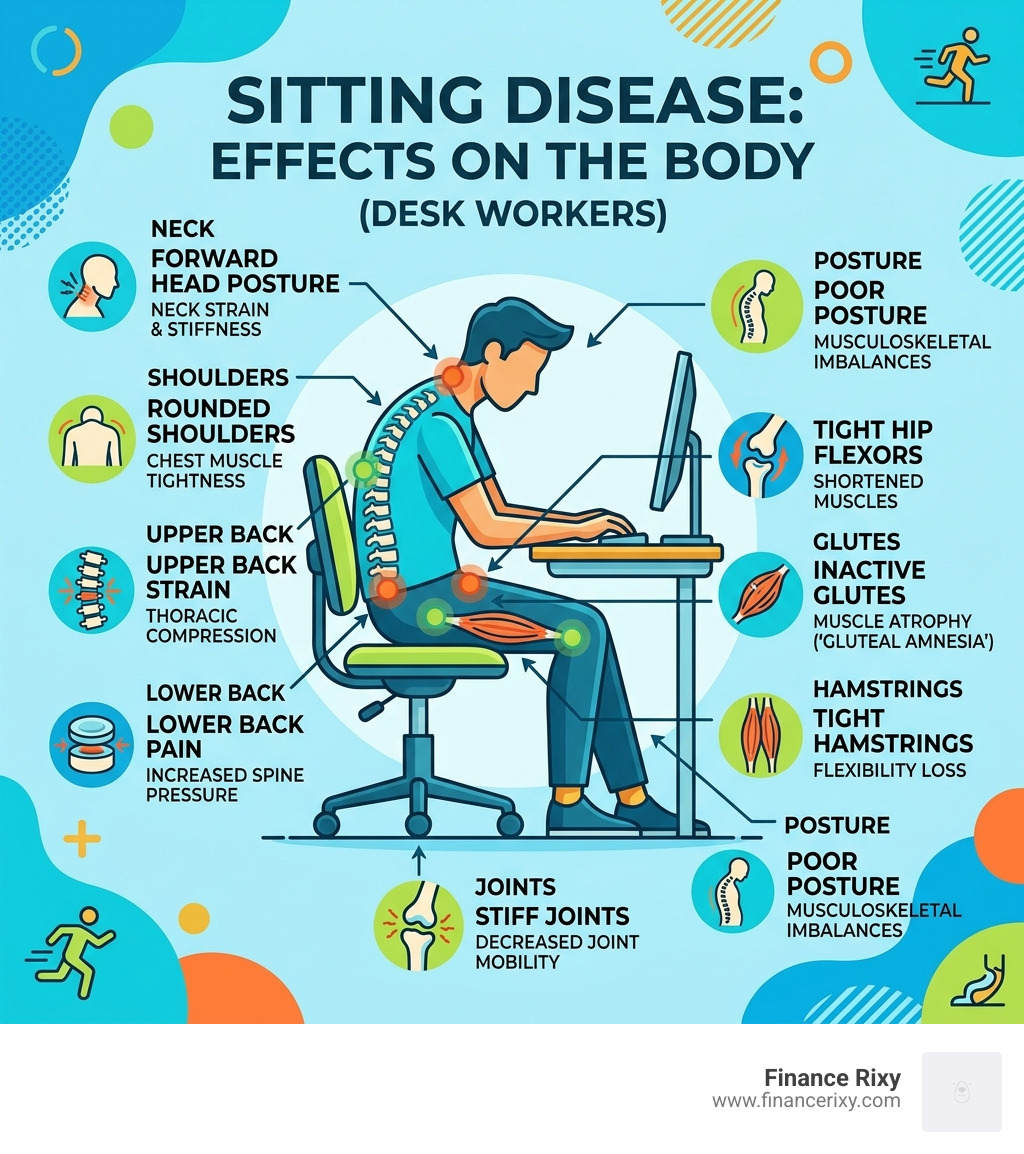
Why Mobility Exercises for Desk Workers are Essential
As we move through April 2026, the trend of “desk potatoes”—workers who remain sedentary for eight or more hours—continues to be a major health hurdle. When we sit, our bodies aren’t just resting; they are actively adapting to a seated position. This “postural adaptation” means our hip flexors shorten, our glutes “turn off,” and our chest muscles tighten, pulling our shoulders into a permanent slouch.

By integrating mobility exercises for desk workers, we can effectively hit the “reset” button. Mobility is different from simple flexibility; while flexibility is about the length of a muscle, mobility is about your ability to move a joint through its full range of motion with control and strength.
The benefits of regular movement include:
- Chronic Pain Reduction: Periodic stretching can slash workplace pain levels significantly.
- Improved Circulation: Moving helps blood flow to the brain and extremities, reducing that “sluggish” feeling.
- Joint Lubrication: Movement triggers the production of synovial fluid, which acts like oil for your joints.
- Mental Clarity: Short breaks improve focus and reduce workplace fatigue.
Static Sitting vs. Active Micro-Breaks
| Feature | Prolonged Static Sitting | Active Micro-Breaks (Every 30-45 min) |
|---|---|---|
| Muscle State | Shortened, tight, and inhibited | Lengthened and engaged |
| Spinal Load | High (especially in the cervical/lumbar areas) | Decompressed and neutral |
| Circulation | Pooled in legs, reduced to brain | Stimulated throughout the body |
| Pain Levels | Increases over time (stiffness) | Reduced by up to 72% |
12 Essential Mobility Moves to Do at Your Desk
You don’t need a yoga mat or a change of clothes for these. Most of these moves can be done in your office chair or using your desk for support. Remember to breathe deeply throughout each move—exhaling as you lean into a stretch allows for a greater range of motion.
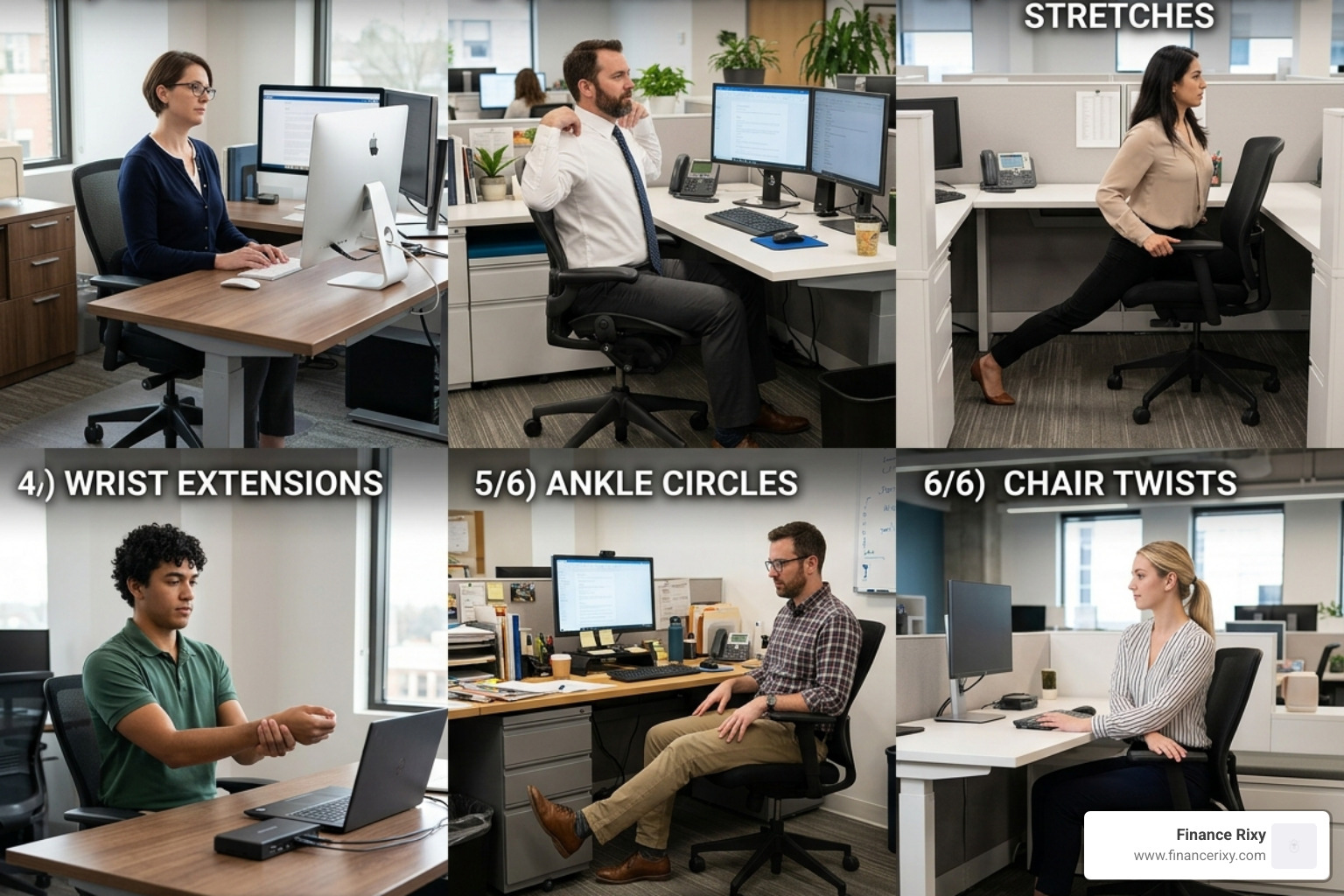
1. Neck Glides and Chin Tucks
Forward head posture—often called “Tech Neck”—is a massive problem. For every inch your head shifts forward from its neutral position, the effective load on your cervical spine increases by roughly 10 pounds.
- How to do it: Sit tall and look straight ahead. Without tilting your head up or down, slowly tuck your chin back as if making a “double chin.” You should feel a stretch at the base of your skull.
- Repetitions: Hold for 3 seconds and repeat 8–10 times.
- Safety: Avoid any sharp pain; keep the movement small and controlled.
2. Shoulder Rolls and Shrugs
We often carry our stress in our traps, leading to “earring shoulders” where our shoulders creep up toward our ears.
- How to do it: Inhale and lift both shoulders toward your ears. Squeeze for 1-2 seconds, then roll them back and down as you exhale.
- Repetitions: Complete 10 reps in each direction (forward and backward).
- Benefit: This releases trapezius tension and improves scapular mobility.
3. Seated Chest Opener
Hours of typing cause the pectoral muscles to tighten, pulling the shoulders forward. This move is a high-impact “antidote” to slouching.
- How to do it: Sit at the edge of your chair. Clasp your hands behind your back. Straighten your arms and gently lift your hands away from your body while pushing your chest out and raising your chin slightly.
- Hold time: 10–30 seconds.
- Repetitions: 5–10 times.
4. Seated Spinal Twist
This is excellent for releasing tension in the mid-back (thoracic spine) and improving trunk rotation.
- How to do it: Sit with feet flat on the floor. Place your left hand on your right knee and your right hand on the back of your chair. Gently twist your torso to the right, looking over your right shoulder.
- Hold time: 2–3 deep breaths per side.
- Source: For more variations, see The Ultimate ‘Deskercise’ Routine.
5. Desk Plank and Push-Ups
Desk workers often lose core endurance because the chair provides all the support. We need to remind the core and upper body how to work.
- How to do it: Place your hands on the edge of a sturdy desk (ensure it won’t slide!). Step your feet back until your body is in a straight line. Hold this “plank” or perform push-ups by lowering your chest toward the desk.
- Repetitions: Try 20 push-up reps or a 30-second plank hold.
6. Hip Flexor Chair Stretch
Sitting keeps the psoas (hip flexor) in a shortened state. This is the single most common driver of desk-related lower back pain.
- How to do it: Stand next to your chair. Place one foot on the seat (or lunge back on the floor). Tuck your pelvis under and squeeze your glute on the trailing leg side. Lean forward slightly until you feel a stretch in the front of your hip.
- Hold time: 20–30 seconds per side.
7. Seated Figure-4 Stretch
This targets the glutes and piriformis, which often become tight and “numb” from sitting.
- How to do it: While seated, cross your right ankle over your left knee. Keeping your back flat, gently lean forward from the hips.
- Hold time: 20–30 seconds per side.
- Precaution: If you have knee pain, flex your foot to protect the joint.
8. Wrist and Forearm Rolls
Typing and mouse use create repetitive strain. These rolls promote blood flow and offset carpal tunnel symptoms.
- How to do it: Extend your arms. Clench your fists and roll your wrists in circles. Then, open your hands wide, stretching your fingers, and close them again.
- Repetitions: 10 circles each way.
9. Chair Squats
This move re-engages the posterior chain (glutes and hamstrings) and gets the blood moving in the lower body.
- How to do it: Stand in front of your chair. Lower your hips as if you are going to sit down, but stop just before your glutes touch the seat. Stand back up.
- Repetitions: 15 reps.
10. Standing Calf Raises
Prolonged sitting can lead to swelling in the ankles and poor circulation in the legs.
- How to do it: Stand behind your chair and hold the back for balance. Lift your heels as high as possible, then slowly lower them.
- Repetitions: 3 sets of 10 reps.
11. Thoracic Extension (Chair-Assisted)
This is a “spinal decompression” move that helps correct a hunchback posture.
- How to do it: Sit in a chair with a mid-height back. Place your hands behind your head. Gently lean back over the top of the chair, looking toward the ceiling.
- Repetitions: 8–10 controlled reps.
- Insight: For more on simplifying your routine, visit Mobility Made Simple.
12. Jump Rope Minus the Rope
This is a “movement snack” that provides a micro-cardio boost and improves coordination.
- How to do it: Stand up and mimic the motion of jumping rope. Stay light on your toes and move your wrists as if holding a rope.
- Duration: 30-second burst.
Creating a Sustainable Desk Mobility Routine
Consistency beats intensity every single time. You don’t need to do all 12 moves at once. Instead, we recommend a “Three-Part Daily Approach”:
- Morning Activation: 5 minutes of dynamic movement (like shoulder rolls and neck glides) to prepare your body for the day.
- Workday Micro-breaks: 1-3 minutes of movement every hour.
- Evening Recovery: Longer holds (like the hip flexor stretch) to release the day’s tension.
Integrating Mobility Exercises for Desk Workers into Your Schedule
The biggest obstacle to posture correction is not ability—it is consistency. Here is how we recommend making it a habit:
- The Pomodoro Technique: Work for 25-50 minutes, then take a 5-minute movement break.
- Movement Triggers: Attach a stretch to an existing habit. For example, every time you finish a phone call, do 10 shoulder rolls. Every time you refill your water bottle, do a calf stretch.
- Phone Reminders: Set an alarm to go off every 45-60 minutes to remind you to “Stop the Slouch.”
- Walking Meetings: If a meeting is audio-only, walk around your office or home while you talk.
Ergonomic Setup to Support Mobility Exercises for Desk Workers
While mobility exercises for desk workers are vital, they work best when your environment isn’t actively fighting you.
- Monitor Height: The top of your screen should be at or slightly below eye level. If you use a laptop, get a separate keyboard and elevate the laptop on a stack of books.
- The 90-Degree Rule: Your elbows should be at 90 degrees when typing, and your knees should be at 90 degrees with feet flat on the floor.
- Lumbar Support: Use a chair that supports the natural curve of your lower back, or place a small rolled-up towel behind your waist.
- Standing Desk Variety: If you have a standing desk, don’t just stand all day—that can be just as static as sitting. The key is to alternate between sitting and standing every 30-60 minutes.
Frequently Asked Questions about Office Mobility
How long does it take to notice improvements in mobility?
You will likely feel an immediate reduction in tension after just one session of mobility exercises for desk workers. However, to see lasting changes in your posture and a significant reduction in chronic pain, consistency is key. Research suggests that meaningful postural improvement and muscle adaptation typically take between 4 to 8 weeks of daily practice.
Can I perform these exercises without breaking a sweat?
Absolutely. These are low-intensity movements designed to be “office-friendly.” You can perform them in professional attire without needing a shower afterward. The goal is joint health and muscle activation, not a high-intensity workout.
What are the signs that I should see a professional?
While these exercises are safe for most people, you should consult a physiotherapist or doctor if you experience:
- Sharp, stabbing, or radiating pain.
- Numbness or tingling in your hands or feet.
- Persistent stiffness that doesn’t improve after 8 weeks of consistent movement.
- Morning stiffness that lasts longer than 45 minutes.
Conclusion
Your physical well-being is the foundation of your productivity and long-term health. By turning these 12 mobility moves into daily habits, you can stop the slouch and protect your body from the “sitting disease.” At Finance Rixy, we believe that small, targeted changes in your daily routine lead to substantial improvements in your quality of life.
Whether it’s a quick neck glide during a conference call or a hip stretch while your coffee brews, every movement counts. Start today by picking just three moves and setting a reminder on your phone. Your future self—free from aches and full of energy—will thank you.
Ready to take the next step in your wellness journey? Improve your daily mobility habits with our expert-backed guides and start feeling better today.
Top 12 Mobility Exercises to Do at Your Desk | Sunny Health & Fitness The Ultimate ‘Deskercise’ Routine: Stretches for the Office – Healthline Mobility Made Simple: Daily Stretch Routines to Undo Desk-Job …
