
The best office routines to keep you limber in your home office
Why Your Desk Job Is Slowly Curving Your Spine
An anti hunchback office routine is the fastest way to fight back against the rounded shoulders and stiff upper back that come from sitting at a desk all day.
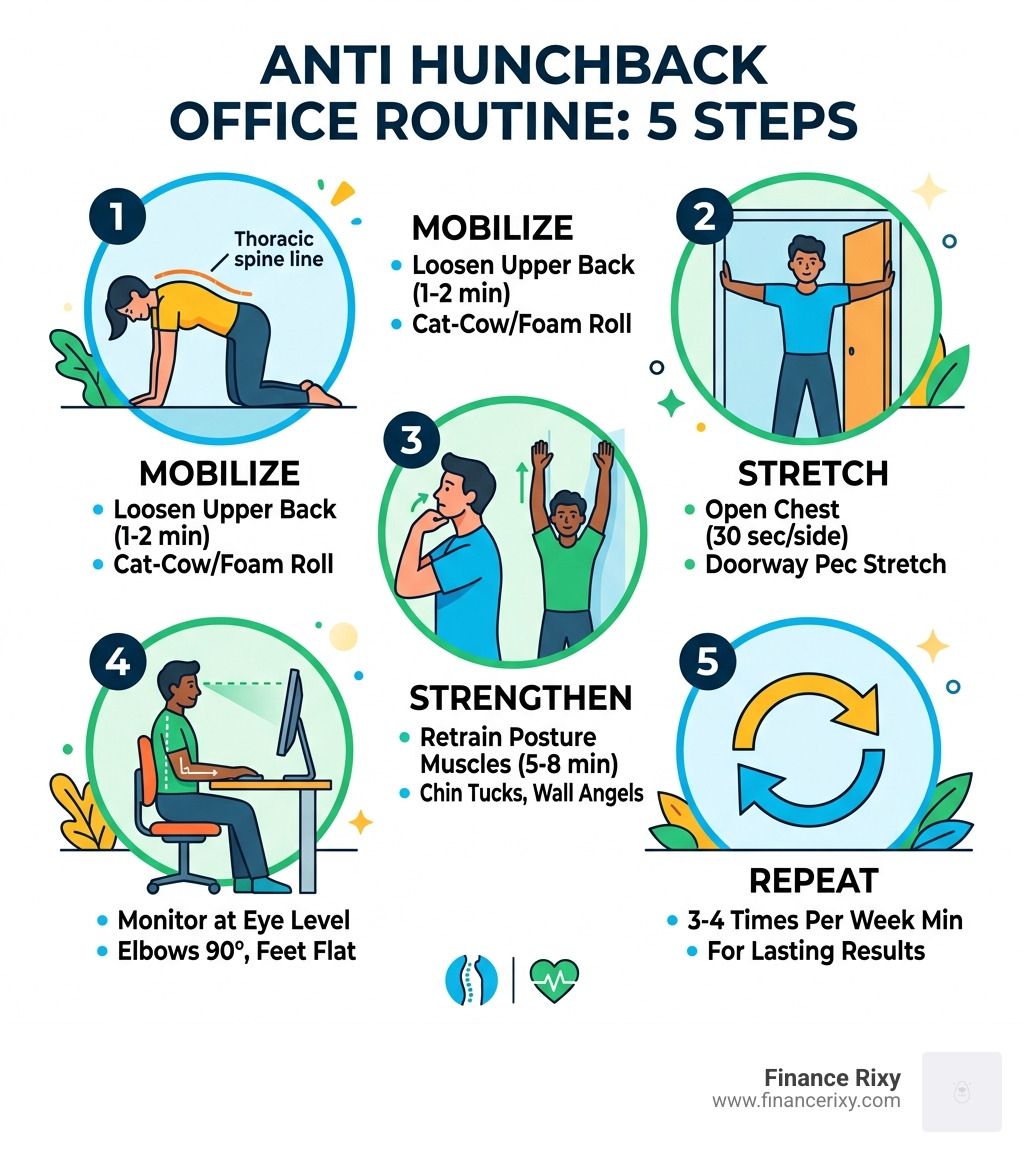
Quick answer — here’s what an effective anti hunchback office routine includes:
- Mobilize — foam roll or cat-cow stretch to loosen your thoracic spine (1-2 min)
- Stretch — pec/doorway stretch to open your chest (30 sec each side)
- Strengthen — chin tucks, wall angels, and scapular squeezes to retrain posture muscles (5-8 min)
- Ergonomics — monitor at eye level, elbows at 90°, feet flat on the floor
- Repeat — 3-4 times per week minimum for lasting results
Most desk workers don’t notice the problem until it shows up in a photo — or starts hurting.
Hours of leaning toward a screen tightens your chest muscles and weakens the muscles between your shoulder blades. Over time, your upper back curves forward. This is called postural kyphosis, and it’s increasingly common among people who work at computers.
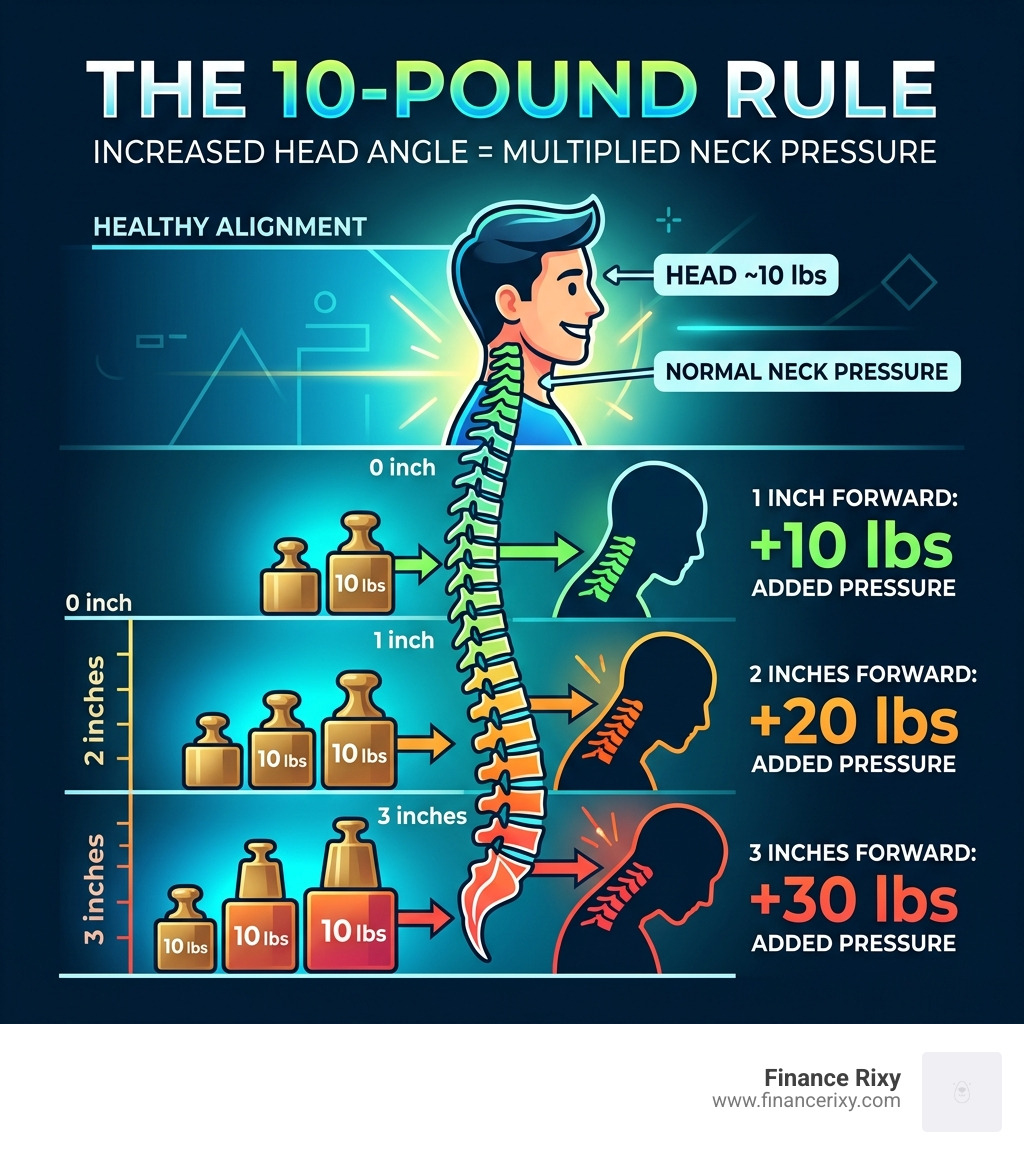
The load adds up fast. Every inch your head drifts forward from your shoulders adds roughly 10 pounds of extra pressure on your spine. A 2-3 inch forward lean — totally normal for desk workers — means 20-30 extra pounds of strain, all day long.
The good news? In most cases, it’s reversible. A 2019 review of studies found that exercise can positively affect the angle of thoracic kyphosis. A 2017 study also showed that combining exercise with posture training measurably reduced spinal curvature.
You don’t need hours in the gym. You need a short, consistent daily routine — and the right moves.
Understanding the “Office Hunch”: Causes and Health Risks
In April 2026, we are seeing more professionals than ever struggling with what is colloquially known as the “office hunch” or “tech neck.” Medically, this condition is often referred to as thoracic kyphosis—an exaggerated outward curvature of the upper spine. When this curvature becomes a permanent fixture at the base of the neck, it is sometimes called a Dowager’s hump.
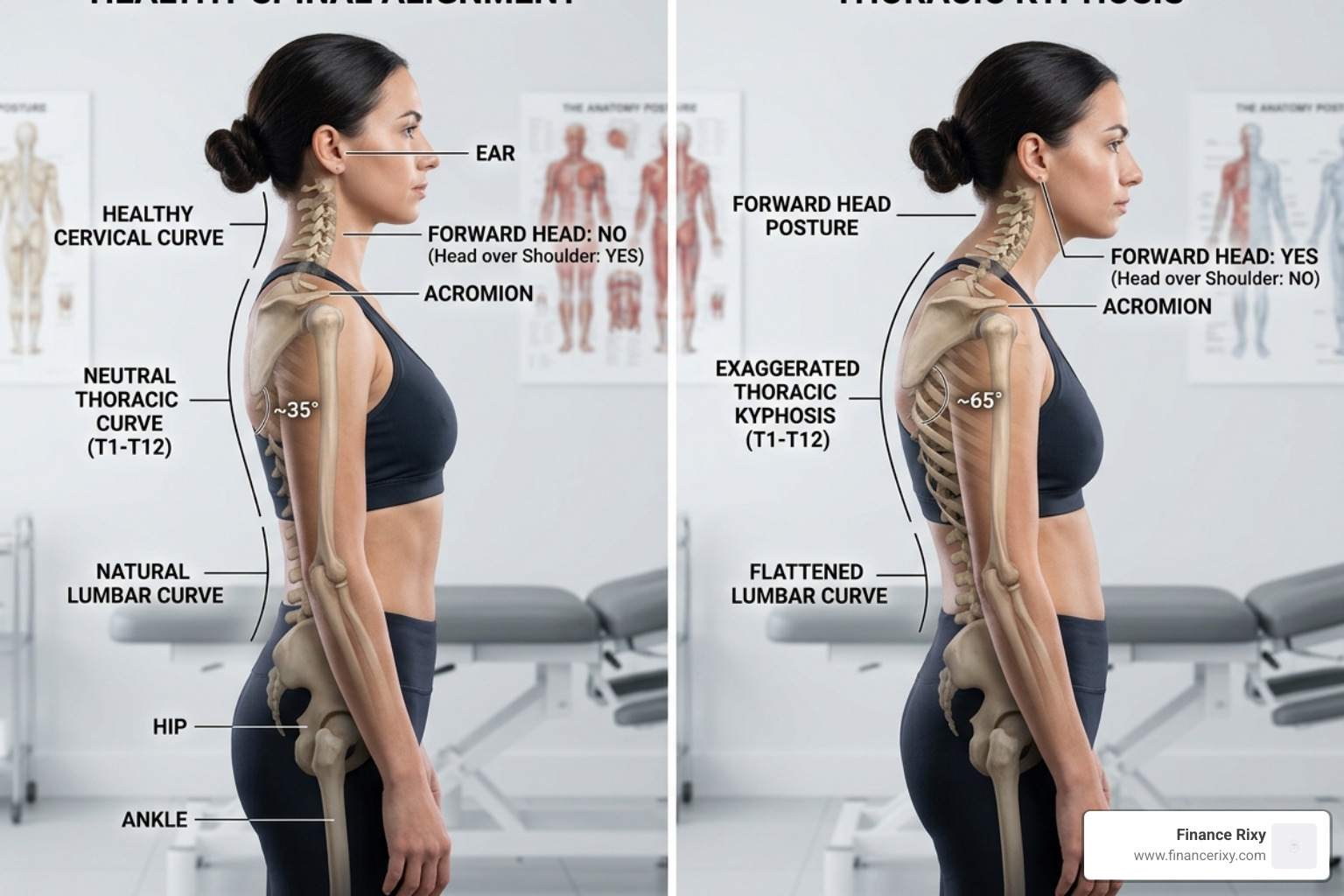
The primary culprit is our sedentary lifestyle. When we sit for eight hours a day, our bodies begin to adapt to that specific shape. This creates a “perfect storm” of muscle imbalances:
- Tight Muscles: Your pectoral (chest) muscles and the muscles at the base of your skull become shortened and hyper-active.
- Weak Muscles: The muscles that pull your shoulder blades back (rhomboids and middle trapezius) and your deep neck flexors become overstretched and weak.
This isn’t just an aesthetic issue. According to Scientific research on the causes of hunchback posture, untreated postural kyphosis can lead to accelerated spinal degeneration, osteoarthritis, and even compression fractures in severe cases. Furthermore, a rounded back compresses the ribcage, which can lead to shallow breathing and reduced lung capacity. Every inch your head juts forward adds significant mechanical stress, leading to tension headaches and jaw pain.
The Ultimate 15-Minute Anti Hunchback Office Routine
At Finance Rixy, we believe that your health is your greatest asset. You don’t need a full gym setup to reverse these trends; you just need 10-15 minutes of focused effort. The key to an effective anti hunchback office routine is consistency. By performing these movements daily, you are essentially “reminding” your nervous system where your bones are supposed to sit.

This routine focuses on three pillars: Mobilization (loosening the “stuck” joints), Stretching (lengthening the tight tissues), and Strengthening (activating the dormant muscles). As highlighted in The Real Fix for Hunchback Posture, the goal is to create lasting muscle memory so that “good posture” eventually feels natural rather than forced.
Essential Stretches for Your Anti Hunchback Office Routine
Before we strengthen the back, we must open the front. If your chest is tight, no amount of back strengthening will pull you upright.
- Pec Stretch / Doorway Lunges: Stand in a doorway with your arms in a “cactus” or “Y” position against the frame. Gently lean forward until you feel a deep stretch across your chest. Hold for 30 seconds. This counteracts the “sunken chest” look common in office workers.
- Cat-Cow: On your hands and knees, inhale as you drop your belly and look up (Cow), then exhale as you arch your back like a cat. This mobilizes the entire spine.
- Thoracic Foam Rolling: Place a foam roller horizontally under your mid-back. Support your head with your hands and gently lean back over the roller. This “unlocks” the stiff vertebrae in your upper back.
- Thoracic Mobility Rainbows: Lie on your side with your knees stacked. Reach your top arm in a giant circle (like a rainbow) over your head and behind you, following your hand with your eyes. This opens up rotational mobility.
Strengthening Drills in an Anti Hunchback Office Routine
Once you’ve opened up the tight areas, it’s time to “turn on” the muscles that keep you upright.
- Chin Retractions (Chin Tucks): Sit tall and draw your chin straight back, as if making a double chin. Do not tilt your head up or down. This strengthens the deep neck flexors and reverses forward head posture.
- Wall Angels: Stand with your back, head, and heels against a wall. Mimic a “snow angel” motion with your arms, keeping your elbows and wrists in contact with the wall the entire time. This is deceptively difficult but highly effective.
- Scapula Retractions: Simply squeeze your shoulder blades together and down, as if trying to put them in your back pockets. Hold for 10 seconds and repeat.
- Prone Y-W-T Series: Lie on your stomach. Lift your arms into a ‘Y’ shape, then pull them down into a ‘W’, then out to the side in a ‘T’. Perform 10-15 reps of each.
- Superman Exercise: Lie face down and simultaneously lift your arms and legs off the floor. This builds the entire posterior chain and core stability.
Ergonomic Workstation Setup to Prevent Slouching
All the exercises in the world won’t help if you spend the other 23 hours of your day in a “C” shape. Your environment dictates your posture. In April 2026, ergonomic technology has advanced, but the fundamentals remain the same.
| Feature | Non-Ergonomic Setup | Orthopedically Sound Setup |
|---|---|---|
| Monitor Height | Looking down at a laptop | Top of screen at or slightly below eye level |
| Elbow Angle | Reaching forward or up | 90-degree bend, elbows tucked to sides |
| Back Support | Slumping in a kitchen chair | Lumbar support maintaining the ‘S’ curve |
| Feet Position | Crossing legs or dangling | Flat on the floor or on a footrest |
| Wrist Position | Bent at odd angles | Neutral and straight |
To maintain a healthy anti hunchback office routine, consider a standing desk. Alternating between sitting and standing every 30-60 minutes prevents any single muscle group from becoming too fatigued. For a deep dive into setting up your space, check out The PERFECT 10 Minute Daily Posture Routine.
Posture Correctors and Tech Aids: Are They Effective?
We often get asked if posture braces are a “cheat code” for spinal health. The answer is nuanced. Posture correctors can be divided into passive and active aids.
- Passive Aids (Braces): These physically pull your shoulders back. While they provide an immediate “straight” look, they can be risky. If worn all day, your muscles “turn off” because the brace is doing the work for them. This can lead to further muscle weakening. We recommend using them as “training wheels” for no more than 30-60 minutes a day to build awareness.
- Active Aids (Digital Reminders): These are small wearable devices that vibrate or provide haptic feedback when you start to slouch. These are generally superior because they force you to use your own muscles to correct your position, building long-term muscle memory.
In April 2026, digital posture gadgets have become incredibly discreet, often clipping onto a shirt or sticking to the upper back. Use these tools as reminders, not crutches.
Frequently Asked Questions about Hunchback Prevention
How long does it take to reverse a postural hunchback?
Most people begin to feel less “stiff” within the first two weeks of a consistent anti hunchback office routine. Visible changes in posture typically take 4-8 weeks of daily commitment. For a full correction of long-standing postural kyphosis, expect a timeline of 3-6 months. You are undoing years of habits, so patience is required!
Can I fix my posture if I am over 50?
Absolutely. While the thoracic curve naturally tends to increase in women between the ages of 50 and 70, research shows that the spine remains adaptable. Exercises focused on flexibility and bone density are crucial at this stage. April 2026 longevity research suggests that even seniors can see a reduction in kyphometer-measured curvature through targeted strength training and mobility work.
When should I see a doctor for a rounded back?
If your curve is “fixed” (meaning you cannot straighten it even when trying), you may have structural kyphosis, which requires professional medical help. Seek a doctor immediately if you experience:
- Severe or persistent back pain.
- Numbness, tingling, or weakness in the arms or legs.
- Difficulty breathing or shortness of breath.
- Changes in bladder or bowel function.
Conclusion
At Finance Rixy, our mission is to help you integrate wellness into your professional life. Your “office hunch” didn’t develop overnight, and it won’t disappear in a single session. However, by adopting a proactive anti hunchback office routine, optimizing your ergonomics, and staying mindful of your alignment, you can protect your spinal health for decades to come.
Start small: do one doorway stretch today. Set a timer to check your posture every hour. These tiny habits are the foundation of long-term physical well-being. For more expert guidance on maintaining your health while crushing your career goals, visit our wellness services page. Let’s make April 2026 the year you stand taller!
