
Elevate Your Game by Elevating Your Legs
Why Leg Up Wall Recovery Belongs in Your Daily Routine
Leg up wall recovery is one of the simplest, most effective things you can do for your body after a long day at a desk or a tough workout.
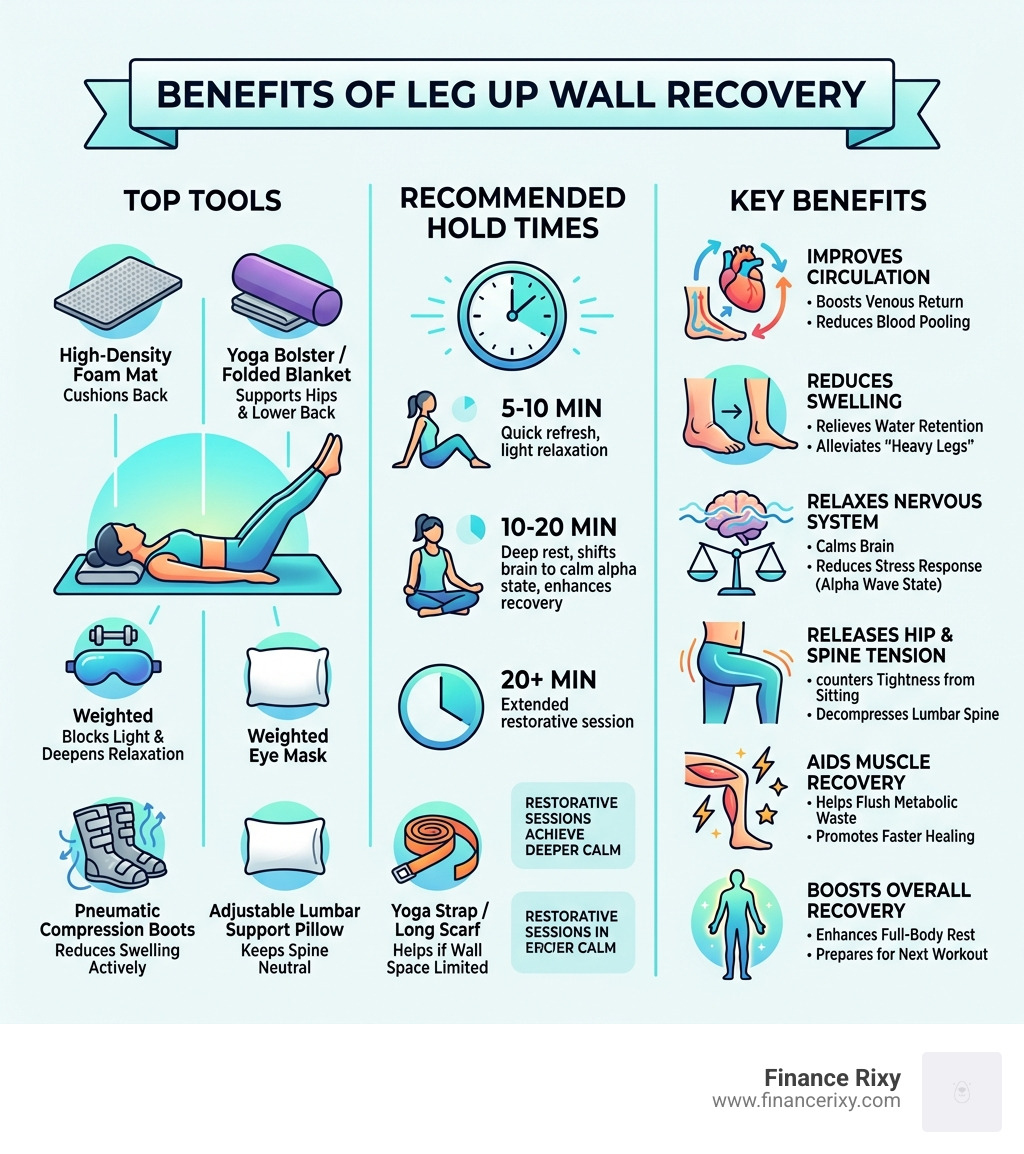
Quick answer — top leg elevation recovery tools to look for:
- High-density foam mat — cushions your back during the pose
- Yoga bolster or folded blanket — supports the hips and lower back
- Weighted eye mask — blocks light and deepens relaxation
- Pneumatic compression boots (e.g., Normatec-style) — reduces swelling actively
- Adjustable lumbar support pillow — keeps your spine neutral against the floor
- Yoga strap or long scarf — helps if wall space is limited
If you spend six or seven hours a day sitting at a desk, gravity is quietly working against you. Blood and fluid pool in your lower legs. Your hip flexors tighten. Your shoulders round forward. Your neck carries what can feel like the weight of a bowling ball.
The legs-up-the-wall pose — known in yoga as Viparita Karani, Sanskrit for “inverted in action” — directly counters all of that. You lie on your back, raise your legs up a wall, and let gravity do the work in reverse.
It costs nothing. It needs almost no space. And it works.
Research shows yoga practices like this can have a measurable positive impact on the body’s stress response systems. In a restorative session of at least 15 to 20 minutes, your brain can shift into an alpha wave state — the kind of deep calm that helps balance mental and physical recovery.
The right equipment makes the pose more comfortable, easier to hold longer, and more effective overall. That’s what this guide covers.
The Physiological Benefits of Leg Up Wall Recovery
When we talk about leg up wall recovery, we aren’t just talking about a “feel-good” stretch. There is a profound physiological shift that occurs when you invert your lower body. In our modern lives, we spend the vast majority of our time upright. This means our circulatory system is constantly fighting gravity to move blood from our feet back to our heart.
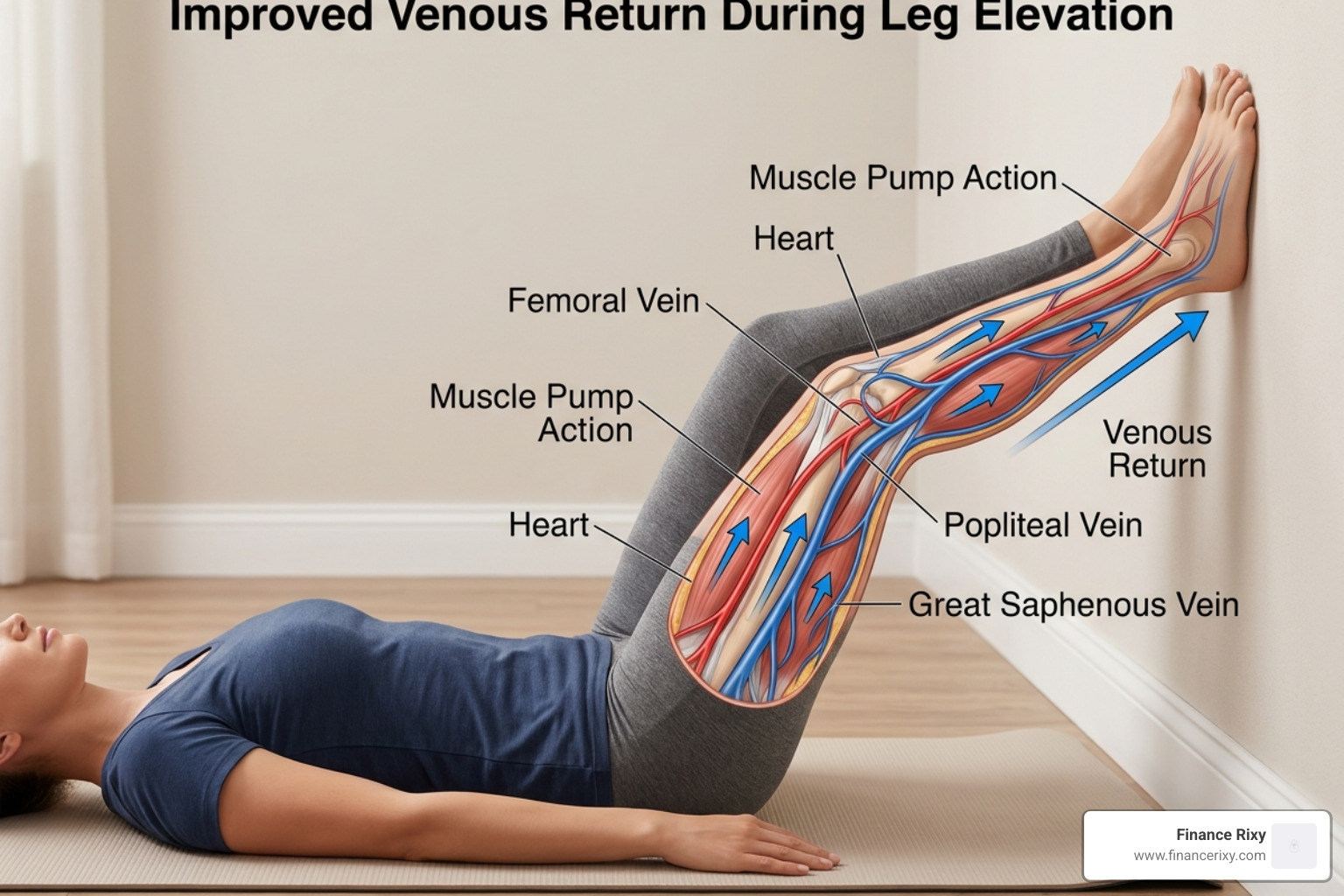
By practicing Viparita Karani, we facilitate “venous return.” Gravity helps the blood flow back toward the heart more efficiently, reducing the workload on our veins. This is particularly beneficial for those of us dealing with venous insufficiency or edema (swelling) in the lower legs.
Beyond blood flow, this pose is a master key for the nervous system. It activates the parasympathetic nervous system—our “rest and digest” mode. As we settle into the pose, our heart rate slows, and our body begins to shed the “fight or flight” tension accumulated during a stressful workday or an intense training session. According to the Cleveland Clinic, this shift helps the body de-stress and can even assist with lymphatic drainage, helping to move extracellular fluid that often leads to “heavy legs.”
Perhaps most impressively, staying in this pose for 15-20 minutes allows the brain to move into an alpha wave state. This state is associated with deep relaxation and a sense of mental “recharge,” making it a perfect tool for overcoming the burnout that often follows chronic stress.
Optimizing Leg Up Wall Recovery for Athletes
For athletes, recovery is just as important as the workout itself. During intense training, muscles undergo stress and micro-tears. Without adequate rest, we risk overtraining, injuries, and decreased performance. Whether you are a marathon runner with tired calves or a figure skater who spends hours in stiff boots, leg up wall recovery is a game-changer.
We’ve seen the power of this pose in action; even the U.S. Olympic figure skating team has been pictured using this posture to manage the physical and mental demands of elite competition. For runners and cyclists, the pose helps drain the metabolic waste that accumulates in the legs after a long effort. While the old myth about “draining lactic acid” is scientifically complex (as we’ll discuss later), the reduction in swelling and the forced period of rest are undeniable performance enhancers.
Advanced Tools for Leg Up Wall Recovery
While you can certainly do this pose on a bare floor, using the right tools can elevate the experience from a simple stretch to a professional-grade recovery session:
- Yoga Bolsters: Placing a bolster under your hips creates a slight incline that further assists venous return and opens the front of the torso.
- Pneumatic Compression Boots: For those looking for the “gold standard,” these boots use air pressure to actively massage the legs and move fluid, often used in conjunction with elevation.
- Lumbar Support Pillows: These ensure that your lower back maintains its natural curve, preventing the “flattening” sensation that can sometimes cause discomfort during long holds.
- Adjustable Slant Boards: Useful for those with extremely tight hamstrings who cannot yet reach a 90-degree angle against a wall.
- Strap Kits: If you find your legs splaying apart, a yoga strap can gently hold them together, allowing your muscles to fully relax.
Essential Equipment for an Elevated Recovery Space
To get the most out of your leg up wall recovery, we recommend creating a dedicated “recovery nook.” This doesn’t have to be a whole room—just a clear patch of wall and a few essentials.

A high-density mat is your foundation; it protects your spine from the hard floor. We also suggest keeping an organic cotton blanket nearby. Because your heart rate drops and your blood flow shifts, it’s common to feel a bit chilly while holding the pose. A weighted eye mask is another favorite of ours—it signals to your brain that it’s time to switch off, facilitating that transition into the alpha wave state.
| Feature | Manual Elevation (Wall) | Pneumatic Compression Tools |
|---|---|---|
| Cost | Free / Low Cost | High Investment |
| Effort | Passive “Non-doing” | Active Massage |
| Main Benefit | Nervous system calming | Rapid swelling reduction |
| Accessibility | Anywhere with a wall | Requires power/equipment |
| Mental State | High (Mindfulness/Meditation) | Moderate (Usually tech-involved) |
One of the greatest “hidden” benefits of this practice is the opportunity for a digital detox. We live in an April 2026 world where we are constantly tethered to our phones. By committing to 15 minutes against the wall without your device, you give your mind a much-needed break from the “FOMO” and constant notifications.
Troubleshooting Your Leg Up Wall Recovery Form
If you feel “pins and needles” or lower back pain, your form might need a slight adjustment.
- Neutral Pelvis: Ensure your tailbone is resting on the floor. If your butt is too close to the wall and your lower back is lifting, scoot back a few inches.
- Sit Bone Alignment: Your sit bones don’t necessarily have to touch the wall. For those with tight hamstrings, being 5-10 inches away from the wall is often more effective.
- Wall Distance: If you feel an intense pull behind the knees, you are too close. The goal is a “hurts so good” stretch, not sharp pain. According to Runner’s World, finding the right distance is key to being able to hold the pose long enough to see results.
Step-by-Step Instructions for Viparita Karani
Ready to try it? Follow our guide for a safe and effective entry into the pose.
- The Sideways Approach: Sit with your left or right hip as close to the wall as possible.
- The Swing: In one fluid motion, lie back on your torso while swinging your legs up the wall. You should end up in an “L” shape.
- Adjusting: Wiggle your hips toward or away from the wall until your lower back feels supported and your hamstrings feel a gentle stretch.
- Arm Positioning: Place your arms out to the sides in a “T” shape to open the chest, or rest your hands on your belly to focus on diaphragmatic breathing.
- The Hold: Close your eyes. Focus on deep, slow breaths. Aim for at least 10 to 15 minutes.
- The Exit: Do not jump up! Pull your knees into your chest and roll onto one side. Rest in a fetal position for 30 seconds to allow your blood pressure to stabilize before sitting up.
Modifications for Every Body Type
We believe wellness should be accessible to everyone. If the standard pose feels difficult, try these:
- Tight Hamstrings: Slide further away from the wall or keep a slight bend in your knees.
- V-Shape Stretch: Open your legs wide to target the inner thighs and groin.
- Butterfly Position: Bring the soles of your feet together and let your knees fall toward the wall to open the hips.
- Neck Support: Use a thin pillow or rolled-up towel under the neck if you feel tension.
- Chair Modification: If you can’t get to the floor, lie on your back and rest your lower legs on the seat of a chair or a sofa at a 90-degree angle.
Safety Guidelines and Medical Contraindications
While leg up wall recovery is generally safe, it is an inversion. This means it temporarily increases pressure in the head and upper body.
Who should avoid this pose?
- Glaucoma: Inversions increase intraocular pressure, which can worsen glaucoma.
- Severe Fluid Retention: If you have congestive heart failure, kidney failure, or liver cirrhosis, the sudden shift of fluid back toward the heart can be dangerous. Always consult a doctor first.
- Unmanaged Hypertension: If your high blood pressure is not controlled by medication, avoid inversions.
- Pregnancy: Many find this pose helpful for swollen ankles, but late-stage pregnancy requires consultation with a healthcare provider to ensure there is no pressure on major vena cava vessels.
- Retinal Detachment: Due to the pressure shift, those with a history of retinal issues should seek medical clearance.
Frequently Asked Questions about Inversion Therapy
Does elevating legs drain lactic acid?
This is one of the most common myths in the fitness world! Modern science tells us that lactate is actually a fuel source, not a waste product. Your body is quite efficient at clearing it on its own through active recovery (like walking). However, leg up wall recovery does help by reducing edema and facilitating the movement of lymph and hydrogen ions, which can contribute to the “burn” and soreness after a workout. So, while it doesn’t “drain” lactic acid in the way people once thought, it absolutely aids the recovery process by encouraging rest and circulation.
How long should I hold the pose for optimal results?
For basic relaxation and a quick “reset,” 5 minutes is great. However, to achieve the alpha wave state and significant reduction in swelling, aim for 15 to 20 minutes. In our experience, the 15-minute mark is where the real magic happens—your mind finally stops racing, and your body fully lets go of muscular tension.
Can I practice this pose every day?
Absolutely. In fact, we encourage it! Making this a part of your evening routine can significantly improve sleep quality. By lowering your heart rate and calming the nervous system before bed, you’re setting yourself up for a much deeper, more restorative night’s rest. It’s a daily habit that pays massive dividends for injury prevention and long-term mobility.
Conclusion
At Finance Rixy, we believe that small, daily habits lead to massive shifts in physical longevity. Leg up wall recovery is the ultimate “low effort, high reward” practice. Whether you’re looking for posture correction after a day at the office or a way to bounce back faster from your weekend long run, this pose offers a sanctuary of “non-doing” in a world that never stops.
By incorporating the right tools—from high-density mats to weighted masks—you can transform a simple wall into a powerful recovery station. Take 15 minutes today to invert your perspective and give your body the rest it deserves.
