
Desk Job Survival Guide: The Best Mobility Breaks
Why Sitting All Day Is Hurting You (And What to Do About It)
Mobility breaks for desk jobs are short movement pauses — stretches, stands, or walks — taken every 20 to 60 minutes to counter the physical damage of prolonged sitting.
Here is a quick overview of what works:
| Break Type | Frequency | Duration | Main Benefit |
|---|---|---|---|
| Micro-break (stretch/stand) | Every 20-40 min | 30-60 seconds | Prevents tissue creep, reduces stiffness |
| Movement break (walk/stretch) | Every 60 min | 2-5 minutes | Cuts neck, shoulder, and back pain |
| Standing interval | Every 30-60 min | 1-3 minutes | Resets posture, improves circulation |
| Full mobility routine | 2-3x per day | 5-20 minutes | Long-term posture and joint health |
The average adult sits for about 6.5 hours a day. For desk workers, that number climbs even higher.
That much sitting takes a real toll. Your spine compresses. Blood flow slows. Muscles stop firing. And by 3 PM, your shoulders are creeping toward your ears and your lower back is quietly screaming.
The problem is not just comfort. Research links sitting for more than 3 hours per day to increased risk of all-cause mortality — regardless of how much you exercise outside of work. One in four adults sits more than 8 hours a day, and half of Americans do not meet basic weekly activity guidelines.
The good news? You do not need a gym, a standing desk, or a long lunch break to fix this. Small, frequent movement resets work better than occasional long stretches. A 2-minute break every 60 minutes has been shown to reduce neck and shoulder pain by 41% and lower back discomfort by 38%.
This guide gives you a practical, beginner-friendly list of the best mobility breaks you can do right at your desk — no equipment, no awkward gym moves, no disruption to your workflow.
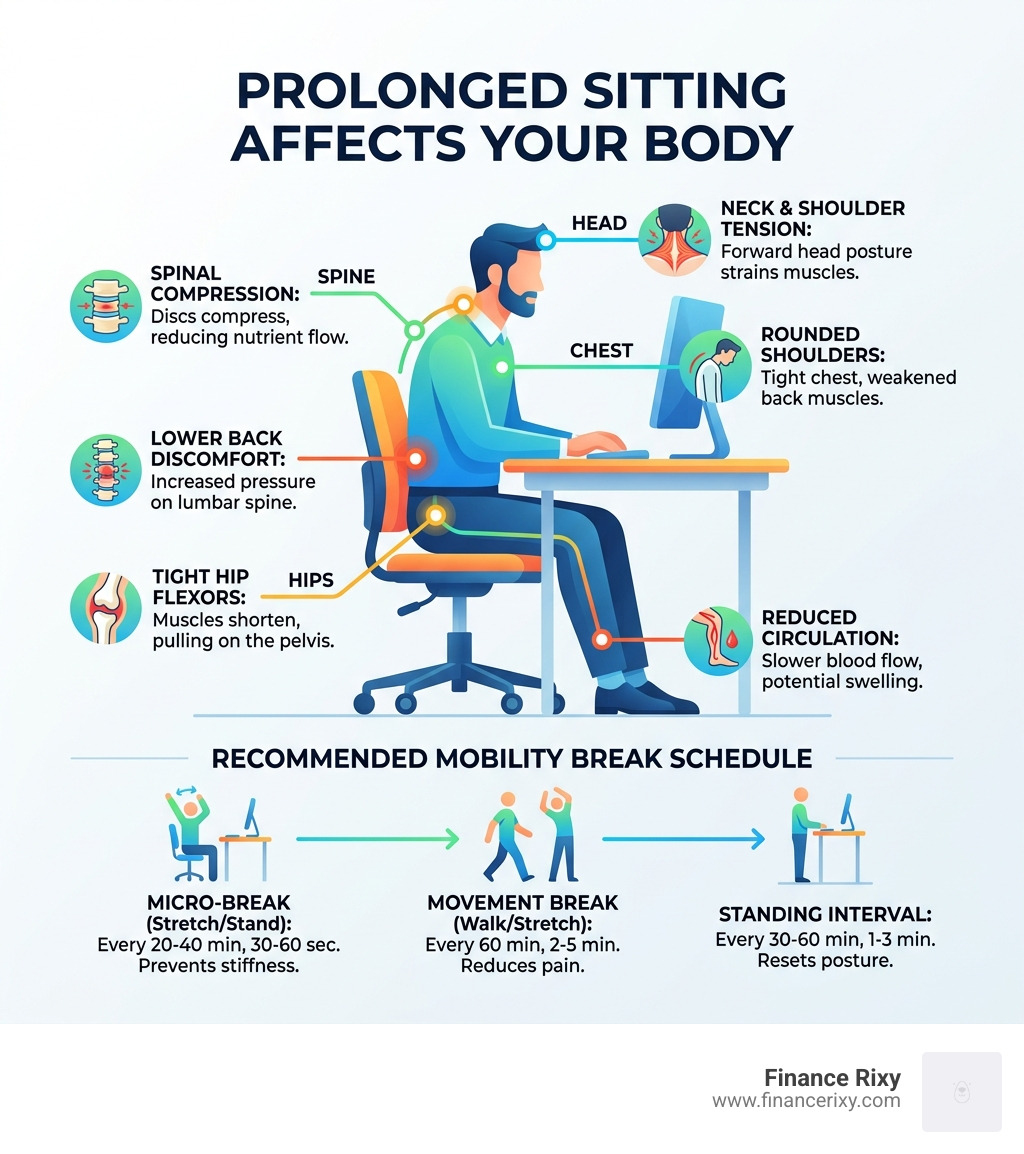
Why Your Body Needs Mobility Breaks for Desk Jobs
In April 2026, we are seeing more desk-bound professionals than ever before. While our minds are racing through emails and spreadsheets, our bodies are essentially stuck in a “folded” position. This static posture is the enemy of musculoskeletal health.
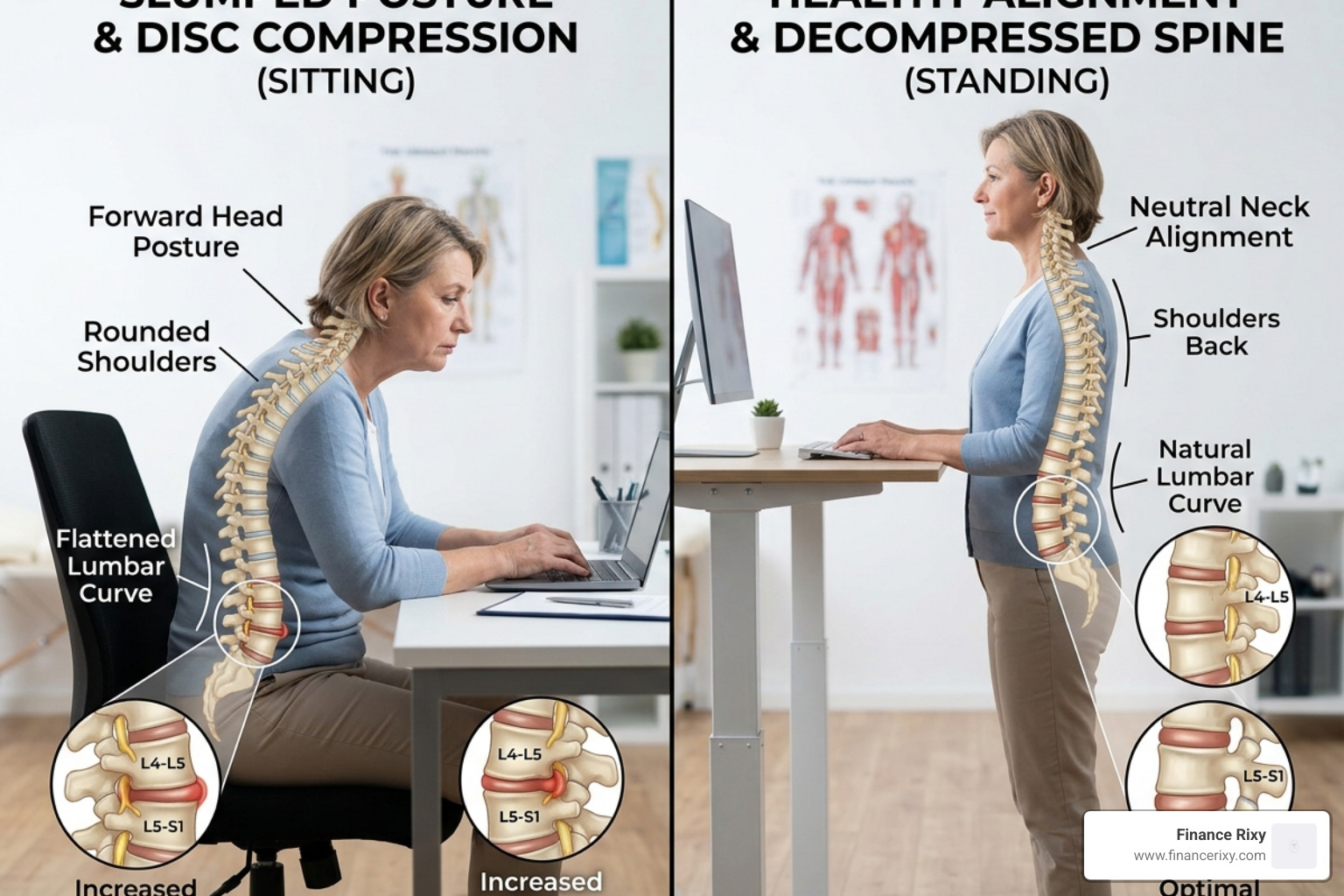
When we sit still for hours, we experience something called tissue creep. This isn’t a character from a horror movie; it’s what happens when your ligaments and discs slowly deform under constant pressure. After just 20 minutes of sustained posture, your lower back tissues begin to stretch and lose their “spring,” leading to that familiar stiffness when you finally stand up.
The Physiological Impact of Prolonged Sitting
The damage isn’t just in your joints. When you remain sedentary, your metabolic system hits the “snooze” button. Research shows that:
- Circulation Drops: Blood pools in your legs, increasing the risk of clots and varicose veins.
- Heart Health Declines: Prolonged sitting is linked to higher blood pressure and cholesterol. In fact, the risk of heart attack for those who sit all day is comparable to the risk associated with smoking.
- Metabolic Slowdown: Your body becomes less efficient at processing blood sugar and fats, increasing the risk of Type 2 diabetes.
- Cognitive Drag: Static posture leads to shallow breathing and reduced oxygen flow to the brain, which we experience as the “afternoon slump.”
How Movement Restores Focus and Productivity
We often skip mobility breaks for desk jobs because we feel too busy. However, staying still actually makes you less productive. Taking a quick break triggers an endorphin release and improves blood flow to the prefrontal cortex—the part of your brain responsible for focus and decision-making.
Think of a 2-minute movement break as a “reboot” for your internal computer. The 5-Minute Desk Stretch Break That Boosts Productivity highlights that these short bursts of activity reduce the “attention tax” created by physical discomfort, allowing you to return to your tasks with sharper mental clarity.
The Ultimate Routine: 10 Essential Mobility Breaks for Desk Jobs
You don’t need to leave your cubicle to save your spine. We have curated a list of the most effective moves that address the “predictable tightness patterns” seen in office workers.

- Seated Cat-Cow: Sit on the edge of your chair with feet flat. Inhale, arch your back, and look up (Cow). Exhale, round your spine, and tuck your chin (Cat). Repeat 5-6 times to hydrate your spinal discs.
- Shoulder Shrugs: Lift your shoulders toward your ears as high as possible, hold for a second, and drop them heavily. Do this 10 times to release upper back tension.
- Neck Rolls: Slowly drop your chin to your chest and roll your head toward one shoulder, then the other. Avoid rolling across the back of your neck.
- Seated Thoracic Rotation: Sit tall, place your right hand on the back of your chair, and gently twist your torso to the right. Hold for 15 seconds and switch. This counters the “hunch” we develop while typing.
- Wrist Flexor Stretch: Extend one arm forward, palm up, and use the other hand to gently pull your fingers back toward your forearm. This is essential for preventing RSI.
- Desk Push-ups: Place your hands on the edge of a sturdy desk, step your feet back, and perform 10 inclined push-ups. This wakes up your chest and core.
- Chin Tucks: Pull your head straight back (creating a “double chin”) without tilting your head up or down. This strengthens the deep neck flexors that support your 10-12 pound head.
- Ankle Circles: While seated, lift one foot and rotate the ankle 10 times in each direction to boost circulation in the lower extremities.
- Overhead Reach: Interlace your fingers and reach toward the ceiling, palms up. Lean slightly from side to side to open up the ribcage.
- Seated Spinal Twist: Cross your right leg over your left and use your left arm to gently pull your right knee across your body while twisting your torso.
For a visual guide, check out this 7-minute stretch break video to follow along in real-time.
Upper Body Mobility Breaks for Desk Jobs
The “Tech Neck” is real. To fight it, focus on opening the front of your body.
- Seated Chest Opener: Clasp your hands behind your back and straighten your arms while lifting your chest. This reverses the rounded-shoulder posture.
- Triceps Stretch: Reach one arm overhead, bend the elbow, and use the opposite hand to pull the elbow toward your head.
- Upper Trap Release: Sit on your right hand and tilt your left ear toward your left shoulder. This provides a deep release for the muscles that carry your stress.
Lower Body Mobility Breaks for Desk Jobs
Sitting keeps your hips in a shortened, tight position.
- Figure-Four Hip Stretch: Cross your right ankle over your left knee. Keep your back straight and lean forward slightly. You’ll feel this in your glutes and outer hip.
- Seated Hamstring Reach: Extend one leg straight out with your heel on the floor. Lean forward from the hips (don’t round your back) until you feel a gentle pull behind the thigh.
- Calf Raises: Stand behind your chair for balance and rise onto your toes. Do 3 sets of 10. This acts as a “second heart” to pump blood back up to your torso.
- Gluteal Sets: Simply squeeze your glutes as hard as you can for 5 seconds, then release. Repeat 10 times. This prevents “dead butt syndrome” where your glutes stop firing properly.
Evidence-Based Schedules: How Often Should You Move?
Consistency beats intensity every time. You are better off moving for 2 minutes every hour than sitting for 8 hours and hitting the gym for 60 minutes.
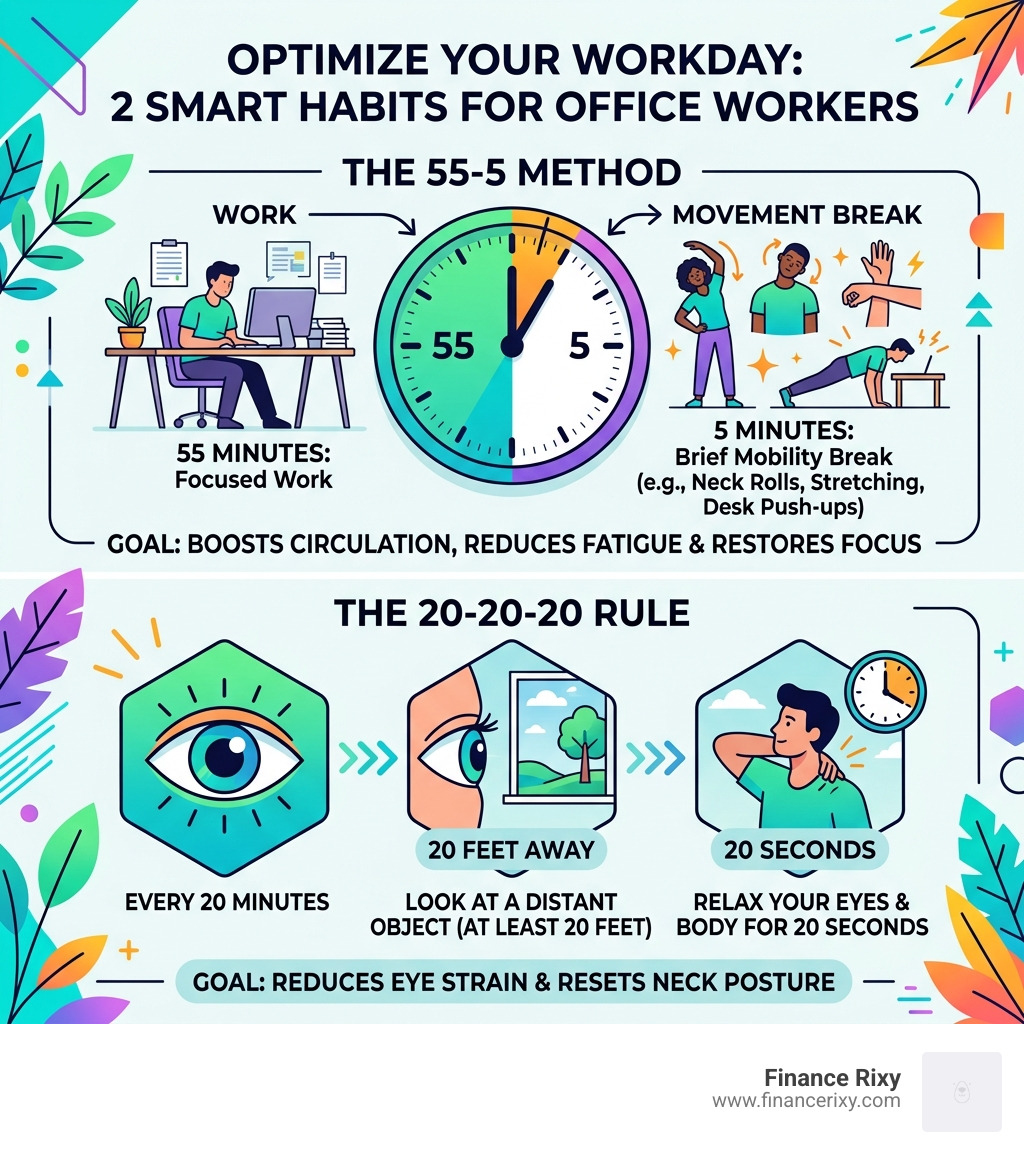
| Strategy | Protocol | Goal |
|---|---|---|
| 20-20-20 Rule | Every 20 min, look 20 feet away for 20 sec | Eye strain and neck reset |
| NASA DeskFit | Alternating stretch/strength days | Full body conditioning |
| 55-5 Method | 55 min work, 5 min movement | Circulation and focus |
| Micro-Habit Stacking | Stretch while the coffee brews | Long-term habit building |
Implementing the 20-Minute Reset
NASA research suggests that micro-breaks as short as 30 seconds every 20 minutes can prevent measurable tissue creep in the lumbar spine. If you use a standing desk, standing still is also a static posture. We recommend alternating between sitting and standing every 30 to 60 minutes. Standing should be viewed as a “posture reset,” not a permanent replacement for sitting.
Strategies for Busy Meeting Schedules
We know that back-to-back Zoom calls make it hard to disappear for a walk. Try these “stealth” mobility breaks for desk jobs:
- Walking Meetings: If you don’t need to share your screen, take the call on your mobile and walk around the office or your home.
- Pacing: If you are on a “camera-off” call, stand up and pace your room. You can easily clock 1,000 steps during a 10-minute update.
- Isometric Exercises: Squeeze your core or your glutes while listening. No one will notice, and you’ll improve blood flow.
- Task Transitions: Make it a rule that every time you finish an email or close a project file, you must stand up and reach for the ceiling.
Common Mistakes to Avoid During Mobility Breaks
When we start a new wellness routine at Finance Rixy, we want to make sure it’s sustainable and safe. Avoid these common pitfalls:
- Over-stretching: Never push a stretch to the point of pain. It should feel like “good tension,” not a sharp pull.
- Holding Your Breath: Many people hold their breath when they concentrate on a stretch. This tenses the nervous system. Instead, exhale as you lean into the movement to enhance your range of motion.
- Static Overload: Don’t just hold one position. Incorporate dynamic movements (like arm circles or leg swings) to get the blood flowing.
- Poor Form: Hunching over while doing a “stretch” defeats the purpose. Always prioritize a long spine and tucked tailbone.
- Consistency Gaps: Moving once on Monday doesn’t help on Friday. Use timers or phone apps to keep yourself honest.
Frequently Asked Questions about Mobility Breaks
Do mobility breaks interrupt deep work flow?
Actually, the opposite is true. Research from Cornell and other institutions shows that micro-breaks help maintain a higher level of performance throughout the day. A 2-minute “reset” prevents the cognitive decline that happens when your body feels stiff and tired. Think of it as sharpening the saw so you can cut faster.
Can short stretches really prevent chronic back pain?
Yes. Most chronic back pain in office workers is caused by cumulative stress—small amounts of pressure building up over years. By interrupting that pressure every 30-60 minutes, you prevent the “tissue creep” and disc compression that eventually lead to chronic issues. For more targeted moves, see these Top 12 Mobility Exercises to Do at Your Desk.
What are the best discreet exercises for an open office?
If you’re worried about looking silly, focus on “invisible” moves:
- Seated Leg Extensions: Straighten your legs under your desk.
- Glute Squeezes: No one can see this!
- Calf Raises: Do these while standing at the printer or making coffee.
- Neck Side Bends: These just look like you’re pondering a difficult problem.
Conclusion
At Finance Rixy, we believe that your job shouldn’t come at the cost of your health. Incorporating mobility breaks for desk jobs is one of the simplest, highest-return investments you can make in your well-being. By moving for just a few minutes every hour, you can lower your blood pressure, boost your mood, and ensure that your body feels as sharp as your mind by the end of the day.
Movement is preventative medicine. Start small—pick two stretches from this list and do them today. Your spine will thank you!
